
Views: 0 Author: Site Editor Publish Time: 2026-05-29 Origin: Site


Cold storage facilities operate under extreme thermal stress every single day. Even minor insulation failures quickly lead to dangerous condensation, heavy frost build-up, and massive energy spikes. You might wonder if spray foam insulation can truly guarantee long-term temperature stability in such demanding environments. The answer is a resounding yes, but there is a major caveat. Success relies entirely on pairing closed-cell polyurethane with a highly calibrated, temperature-controlled Polyurethane Foam Spray Machine. This specialized equipment maintains consistent dynamic pressure and delivers precise chemical heating. These specific machine capabilities prevent long-term thermal bridging and eliminate material sagging over time. In this comprehensive guide, we will explore exactly how machine precision dictates insulation success. You will discover the science behind R-value maintenance, why heating capacities matter, and how to select the right proportioning equipment for your commercial cold room projects.
Commercial refrigeration environments demand materials capable of surviving relentless thermal cycling. Traditional insulation methods often fall short when subjected to decades of continuous freezing operations.
Historically, builders relied on rigid foam boards or fiberglass to insulate cold rooms. These traditional materials suffer from a fundamental flaw: seams. Every joint between panels creates a potential thermal bypass. Over time, building vibrations and minor settling cause these joints to widen. Cold air escapes, and warm air infiltrates.
Sprayed closed-cell foam eliminates seams entirely. The liquid material expands upon impact, molding perfectly to complex geometries like corrugated roof decks, pipes, and structural beams. Beyond insulation, high-density closed-cell foam actually adds structural rigidity to walls and ceilings. It creates a monolithic envelope. You achieve better thermal resistance while physically strengthening the building shell.
Extreme internal and external temperature differences invariably cause condensation. When warm, humid outside air hits a freezing cold storage wall, moisture drops out of the air. Traditional fibrous insulation absorbs this water. Once wet, its R-value plummets to near zero, and dangerous mold begins to grow.
Closed-cell polyurethane creates a highly effective airtight seal. Because the cellular structure is entirely closed, it aggressively resists moisture infiltration. It prevents humid air from reaching the cold dew point inside the wall cavity. However, professional vapor barrier design remains mandatory. Even the best foam requires a specialized vapor retarder on the warm side of the wall to remain 100% effective over a fifty-year lifespan.
Facility managers constantly battle the "sag and settle" problem. Heavy fiberglass batts or loosely packed cellulose degrade over time. They slide down wall cavities, leaving uninsulated gaps at the top of the wall. This drives up operating costs significantly.
Machine-sprayed polyurethane foam does not degrade, detach, or settle. Once properly proportioned and cured, it bonds tenaciously to the substrate. The material stays permanently locked in place. This guarantees long-term thermal performance and protects the underlying building assets from moisture-driven rot.
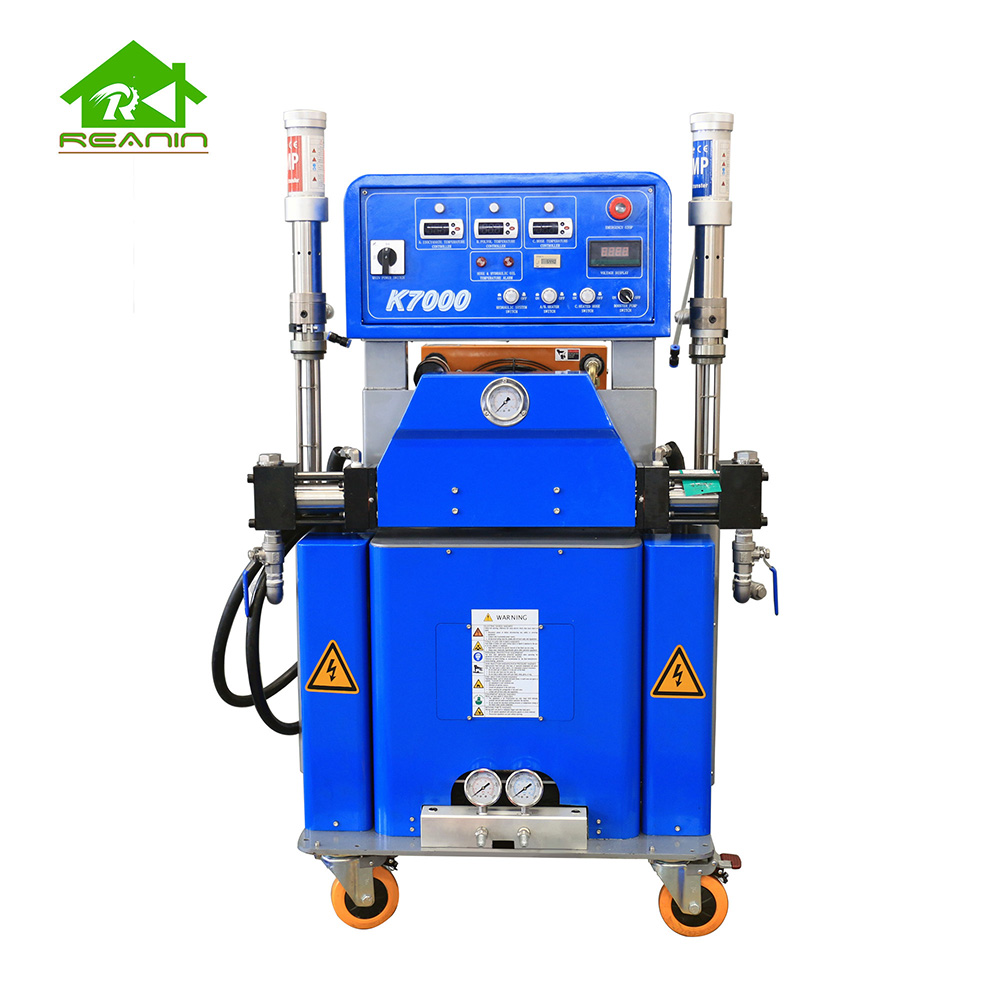
Many people assume the foam itself does all the work. In reality, the insulation is only as good as the machine processing it.
High R-values only exist if the cellular structure of the foam forms perfectly. Closed-cell foam derives its insulating power from millions of tiny, trapped gas bubbles. If these bubbles rupture, interconnect, or fail to expand fully, the R-value drops drastically. Perfect cell formation requires immense mechanical precision.
A commercial Polyurethane Foam Spray Machine plays a critical role here. It ensures exact volumetric mixing of Isocyanate (the A-side) and Resin (the B-side). These chemicals must interact at a strict 1:1 ratio.
When machines suffer from pressure imbalances, they spray "off-ratio" foam. Off-ratio applications create uncured, spongy, or brittle soft spots. In a commercial freezer, an off-ratio patch immediately becomes a thermal leak. Ice forms inside the wall, destroying the surrounding material. Precision proportioning guarantees the foam cures to its intended density and strength.
Stable machine pressure translates directly to uniform foam thickness. If a machine surges or pulses, the operator will spray an uneven layer. Thin spots in the insulation envelope lead to thermal bridging. Thermal bridging forces cold storage compressors to work overtime, fighting a losing battle against heat transfer. High-quality proportioners deliver smooth, consistent fluid flow. This empowers the operator to lay down perfectly even passes, maximizing coverage and yield.
Selecting the correct drive system for your proportioner determines your ultimate success on the job site. Contractors typically choose between pneumatic (air-driven) and hydraulic equipment.
You must carefully frame the equipment decision around project size. For small walk-in coolers or minor retrofits, a pneumatic system might suffice. They are lighter and mechanically simpler. However, for massive cold storage warehouses and industrial food processing plants, a Hydraulic Polyurethane Foam Spray Machine stands as the undisputed industry standard.
Hydraulic systems excel at maintaining consistent dynamic pressure. Commercial jobs often require spraying thick, high-viscosity "winter blend" closed-cell foams. Operators also need to drag hundreds of feet of heated hose deep into massive warehouse footprints.
Pneumatic pumps often stall or drop pressure when pushing thick chemicals through long hoses. Hydraulic pumps easily overpower this resistance. They deliver a relentless, unyielding push. This continuous pressure prevents the mix chamber from crossing over and guarantees an uninterrupted spray pattern.
Hydraulic machines typically feature vastly more robust primary heaters. In the spray foam industry, professionals rely on a metric called "Delta T" (ΔT). This represents the machine's maximum temperature rise limit.
If your raw chemical drums sit at 50°F, you need to heat them to the 130°F range for optimal spraying. That requires a Delta T of 80 degrees. Weak machines cannot heat cold chemicals to the required targets on a single pass. A powerful hydraulic proportioner provides the necessary wattage to rapidly elevate chemical temperatures without slowing down production rates.
| Feature Matrix | Pneumatic Systems | Hydraulic Systems |
|---|---|---|
| Ideal Application | Residential, small retrofits, touch-ups | Large commercial, cold storage, industrial |
| Pressure Consistency | Moderate (susceptible to air compressor drops) | Excellent (sustained dynamic pressure) |
| Delta T Heating Capacity | Standard (often struggles with winter blends) | Superior (rapid, high-volume heating) |
| Maximum Hose Length | Typically limited to 200–300 feet | Can exceed 400 feet with steady pressure |
You must adopt a highly realistic approach to environmental controls. An expensive machine is ultimately only as good as the operator's temperature management.
Industry consensus states that roughly 40% of all spray foam failures are directly temperature-related. When liquid chemicals get cold, they thicken significantly. High viscosity ruins everything. It causes poor spray patterns, reduced yield, and terrible substrate adhesion. The chemicals simply become too thick to mix properly inside the gun. This leads directly to the off-ratio disasters mentioned earlier.
Heating the liquid chemicals inside the machine is only half the battle. While the machine heats the foam to the proper spray temperature, the ambient air and the target substrate must also be warm.
In cold storage applications, contractors often spray onto freezing metal panels or bare concrete. These materials act as massive heat sinks. If the substrate is colder than 40°F to 50°F, it instantly sucks the heat out of the liquid foam upon impact. The chemical reaction crashes. The foam fails to rise, becomes dense, and pulls away from the wall. You must heat the work environment before pulling the trigger.
Direct-fired heaters exhaust massive amounts of moisture directly into the workspace. When this moisture hits cold steel or concrete, it forms an invisible layer of condensation. Spraying foam over this moisture causes catastrophic failure. The foam will react with the water, shrink violently, and pull completely off the wall. Always use indirect heaters or dry electric heating solutions to prepare your substrate.
Commercial proportioners require rigorous maintenance, especially when operating in cold climates. Ignoring seasonal protocols will destroy the internal components of your equipment.
The A-side chemical (Isocyanate) is highly sensitive to cold and moisture. If Isocyanate drops below freezing temperatures or interacts with ambient humidity, it crystallizes. These tiny crystals act like crushed glass. They will irreparably clog heated hoses, ruin proportioner pumps, and score internal seals. Once crystallized, the chemical cannot be thawed or salvaged.
Contractors must establish strict Standard Operating Procedures (SOPs) for storing rigs during cold months.
Protecting the fluid pumps during downtime is just as vital. Operators must always park the proportioner with the pumps fully retracted into the "down position." If you leave the displacement rods exposed to the air, residual Isocyanate on the rod will crystallize. When you start the machine next, those crystals will shred the internal packing seals.
Additionally, always utilize a moisture-free pump lubricant (such as DOP lube) in the wet cup. This stops seals from drying out, cracking, and leaking during extended cold-weather shutdowns.
Buying commercial spray foam equipment requires a thorough evaluation of technical specifications. Use this framework to evaluate potential proportioners for your next cold storage build.
Polyurethane foam machines remain the most effective method for maintaining rigorous cold storage temperatures. However, achieving decades of thermal stability requires more than just buying chemicals. It demands strict adherence to operational best practices and a deep understanding of thermodynamics.
Actionable Next Steps:
A: Yes. If Isocyanate freezes or drops below safe storage thresholds, it forms hard crystals that quickly destroy machine seals and clog hoses. Unfortunately, thawing the chemical later does not reverse this damage. The crystallized material must be entirely flushed and safely discarded to prevent catastrophic machine failure.
A: Shrinkage usually points to spraying on a substrate that was too cold (below 40°F). It can also occur if you used direct-fired heaters that introduced heavy moisture into the room before spraying. Finally, check your equipment; a machine operating off-ratio due to clogged filters will produce unstable foam that shrinks as it cures.
A: Yes. While closed-cell foam is highly moisture-resistant, the extreme temperature differentials found in commercial cold storage create intense vapor drive. Specialized vapor retarders remain necessary to meet strict building codes and prevent deep-wall condensation over decades of heavy use.


