
Views: 0 Author: Site Editor Publish Time: 2026-06-26 Origin: Site


Repurposed shipping containers face soaring demand across global construction markets. We see them heavily utilized as affordable housing, mobile field offices, and modular storage units. However, these robust structures introduce a critical engineering challenge. Corrugated steel walls cause severe thermal bridging and extreme condensation inside the living space. Standard insulation methods often fail completely against the high conductivity and irregular surface of shipping containers.
Spray polyurethane foam (SPF) provides the undisputed industry standard solution. Yet, applying SPF inside an enclosed, solid metal environment demands highly specific equipment capabilities. We designed this comprehensive guide to give technical buyers, insulation contractors, and project managers an evidence-based framework. You will learn exactly how to evaluate and select the correct spray equipment for challenging container projects. We balance your upfront equipment choices with reliable, long-term field performance. This knowledge prevents disastrous foam failures on cold steel.
Closed-cell SPF is mandatory for container projects to prevent moisture buildup; equipment must maintain strict temperature and pressure controls to process this denser foam.
The ideal foam spray machine configuration relies on heated hoses (minimum 50-100 ft) and robust primary heaters to combat heat loss on cold steel surfaces.
Equipment selection should be dictated by project volume (single-unit repurposing vs. high-volume fleet manufacturing) and on-site power availability (single-phase vs. three-phase).
Compliance with EPA safety guidelines for enclosed-space ventilation is non-negotiable and directly impacts equipment setup and hose length requirements.
Steel transfers heat incredibly fast. Corrugated metal walls act as massive thermal bridges in any climate. They pull valuable heat out during winter months. They bake interior spaces during the summer. This rapid, continuous temperature shift creates significant condensation on the inner walls. You need a completely seamless vapor barrier to stop this moisture buildup. Standard fiberglass batts simply cannot conform to corrugated ribs effectively. They leave hidden air gaps behind the insulation. Moisture gathers rapidly in these gaps, causing severe rust and mold.
Spray Polyurethane Foam Alliance (SPFA) standards strongly recommend rigid foam solutions for all structural metal buildings. Open-cell foam absorbs moisture over time. It lacks the necessary vapor barrier properties for solid metal enclosures. Therefore, closed-cell foam remains the only viable PU foam for containers. It provides exceptional structural rigidity. It also offers intense moisture resistance and a high R-value per inch.
Applying this denser foam directly affects your hardware choices. Processing closed-cell chemical formulas requires much higher system pressure than open-cell variants. The equipment demands precise chemical proportioning at a strict 1:1 ratio. The liquid chemicals undergo a violent exothermic reaction when mixed. This reaction must bond correctly to the cold metal surface. If your equipment allows temperature fluctuations, the foam will fail to rise properly. It will ultimately delaminate from the steel, destroying the insulation envelope entirely.
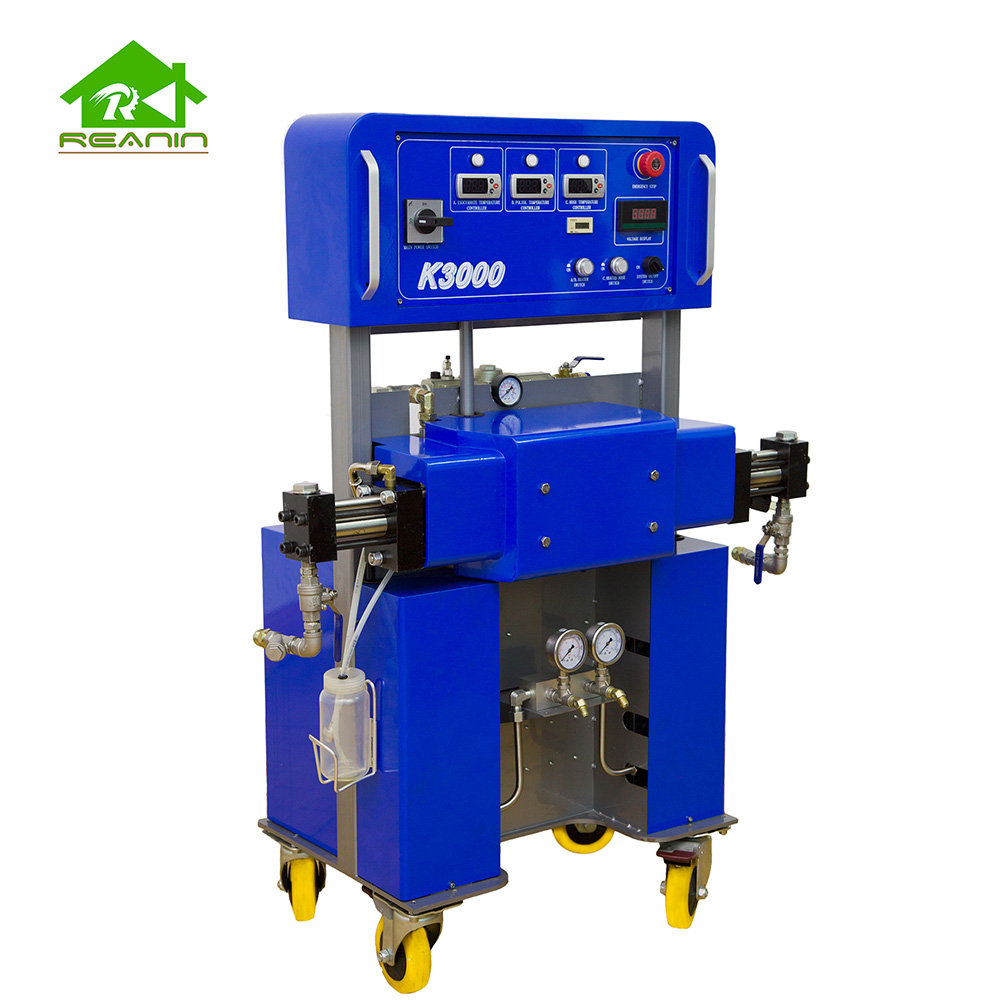
Metal containers act as massive heat sinks. They pull heat away from the reacting foam almost instantly. High-wattage primary heaters are absolutely critical for success. They pre-heat the isocyanate (A) and resin (B) chemicals before the fluid even enters the hose line. We evaluate Delta T performance to measure this heating capacity. Delta T represents the temperature increase a machine can generate from the drum to the hose. A high Delta T ensures chemicals reach optimal temperatures even in freezing outdoor environments.
Next, you must consider the hose architecture. An effective foam spray machine configuration relies heavily on copper-wrapped heated hoses. These hoses need accurate RTD (Resistance Temperature Detector) sensors embedded near the gun. These sensors maintain strict chemical viscosity from the proportioner directly to the spray nozzle. If the hose loses heat, the chemicals thicken. This causes severe pressure imbalances and ruins the cellular foam structure.
Let us evaluate proportioner drive types. You have several distinct choices for your setup:
Air-driven (Pneumatic): These machines offer a much lower entry cost. They suit occasional container modifications perfectly. They rely on an external air compressor to drive the fluid pumps.
Electric Systems: These provide better energy efficiency and consistent strokes. They work well for mid-sized contractors handling steady residential and container work.
Hydraulic Systems: These deliver relentless, consistent pressure for continuous fleet production. They easily prevent pressure drops. Sudden pressure drops cause off-ratio foam during high-volume spraying.
Below is a basic performance comparison chart outlining different drive mechanisms:
Drive Type | Initial Investment | Pressure Consistency | Best Use Case |
|---|---|---|---|
Pneumatic | Low to Moderate | Moderate (requires large compressor) | Occasional container modifications |
Electric | Moderate to High | High (smooth pump switchover) | Mid-volume contractor projects |
Hydraulic | High | Excellent (handles highest viscosities) | Continuous fleet manufacturing |
You also need the right spray gun. We strongly recommend air-purge guns for confined space maneuverability. They offer lightweight profiles and easy maintenance during stop-and-go spraying. You will stop frequently to maneuver around tricky container ribs and tight corners. Air-purge technology blows the mixing chamber clean automatically after every single trigger pull.
Project volume directly dictates your machine size. You must align your output needs against actual hardware capabilities. Buying an undersized machine leads to extreme frustration and burned-out motors.
For entry-level or low-volume projects, you might expect to process one to five containers per month. A recommended output ranges from 15 to 20 lbs per minute. Focus heavily on portability and simplicity. You want a machine requiring lower power draw. You also want straightforward maintenance protocols. Smaller machines fit easily inside a standard cargo trailer. They run comfortably on smaller, manageable generators.
Commercial high-volume operations demand significantly more power. Continuous manufacturing lines require a minimum output of 30+ lbs per minute. Focus your evaluation on high duty cycles. Hydraulic proportioners and integrated drum transfer pumps handle these heavy daily loads best. You need hardware built to run eight hours a day without overheating.
Beware of theoretical data sheets. Many buyers rely solely on maximum output numbers published in brochures. This remains a highly common mistake in the industry. You must evaluate sustained pressure capabilities instead. Evaluating your polyurethane insulation equipment requires looking at continuous run ratings under heavy load. Do not just look at peak output bursts. Off-ratio foam wastes expensive material. It ruins steel adhesion and forces you into costly scraping and rework. Demand verifiable continuous output ratings from your manufacturer.
Power supply issues remain the most common point of equipment failure. A commercial spray rig requires a heavily matched power source. You often need robust 30kW to 45kW diesel generators. These generators must handle immense simultaneous electrical loads. They power the primary heating elements, the heated hose transformer, the fluid pumps, and the large air compressor all at once. If your generator drops voltage under load, your primary heaters lose capacity instantly. This sends cold chemicals to the gun, destroying your foam yield.
Environmental and safety compliance is equally critical. The EPA strictly classifies enclosed shipping containers as confined spaces. Ventilation is not optional. Your machine setup must accommodate sufficient hose length to keep equipment isolated. You typically need 100 to 150 feet of heated hose. This keeps the proportioner, the noisy generator, and all bulk chemicals completely outside in a well-ventilated area.
Furthermore, you must integrate mandatory fresh-air supply systems. Applicators need OSHA-compliant supplied-air respirators (SAR) inside the container. You drive these safety systems using the exact same compressor setup running your transfer pumps and spray gun. Never cut corners on confined space ventilation. Proper machine configuration ensures the compressor has enough output to run the gun, the pumps, and the breathing air simultaneously.
Choosing the right container insulation spray machine requires strict vendor evaluation. Look closely beyond the initial sticker price of the primary proportioner. You must budget accurately for the core machine, the air compressor, the generator, heated hoses, and essential safety gear. Your return on investment depends directly on keeping the equipment running consistently in the field. Downtime is your biggest enemy.
Vendor evaluation criteria should include the following critical factors:
Parts Availability: Ensure you can easily source replacement guns, fluid seals, and heater rods locally or via overnight shipping.
Technical Support: You need immediate help troubleshooting off-ratio chemical mixes on site. Call their support line before buying to test responsiveness.
Warranty Realities: Read the fine print carefully regarding heating elements, fluid pumps, and primary circuit boards.
Watch out for serious red flags during your search. Avoid vendors over-promising incredibly cheap all-in-one machines. These bargain units often lack isolated heating zones for the A and B chemicals. They might use proprietary, non-serviceable parts locked behind long shipping delays. If you cannot fix the machine in the field using standard tools, it will eventually destroy your project timeline. Always prioritize equipment utilizing standard, readily available industrial components.
Container insulation remains a notoriously unforgiving application. Steel thermodynamics and tight confined spaces leave absolutely no room for error. Selecting the right heavy-duty machinery prevents costly foam shrinkage. It stops disastrous delamination on interior metal walls. The correct equipment maintains precise heat and pressure, turning expensive chemicals into perfect closed-cell insulation.
Take immediate action by auditing your typical site power supply first. Calculate your expected monthly material output accurately. Gather these two essential metrics before requesting a custom equipment quote from any manufacturer. Understanding your exact pressure requirements and power limitations ensures you buy exactly what your production scale demands. Plan your equipment setup thoroughly, prioritize safety compliance, and you will produce flawless container insulation projects every time.
A: You typically need 1,000 to 1,200 PSI sustained pressure at the gun. This ensures proper atomization and maintains a tight, moisture-blocking cell structure on the cold steel.
A: Yes, you can use single-phase power for smaller entry-level machines. However, your heating capacity will be limited. High-output closed-cell applications in cold weather generally require three-phase power or a dedicated high-capacity generator.
A: Most mid-to-high tier machines support 210 to 310 feet of hose. Pushing maximum length requires robust transformers and flawless ambient temperature management. For standard 20ft or 40ft containers, a 100-150 ft hose is optimal.
A: Yes. Even if fluid pumps are hydraulic, an air compressor is still required. It powers the air-purge spray gun, the drum transfer pumps, and your mandatory fresh-air respirator systems.


