
Views: 0 Author: Site Editor Publish Time: 2026-07-15 Origin: Site


The power plant acts as the absolute heartbeat of any mobile spray foam or polyurea operation. Without reliable electricity, even the most advanced rigs turn into dead weight on a job site. Undersized or dirty power creates massive operational risks for contractors. It leads to catastrophic proportioner control board failures. It causes improper chemical curing, resulting in dangerous off-ratio sprays. Ultimately, these power failures trigger incredibly costly site downtime. You simply cannot afford equipment crashes when clients expect tight project deadlines.
This guide provides a strictly vendor-agnostic framework. We designed it to help you evaluate, size, and integrate the right electrical solution. High-demand, continuous-use spray applications require specific engineering rules. We will walk you through calculating load profiles and selecting the best alternator type. You will learn how to successfully mount these heavy units inside your mobile trailer. Accurate integration keeps your crew spraying consistently.
Standard construction generators are rarely suitable for spray rigs due to high Total Harmonic Distortion (THD) that damages sensitive electronics.
Proper spray machine power planning requires sizing for continuous load (calculating proportioners, compressors, and heaters), plus a 20% safety margin.
Trailer integration demands precise weight distribution and specialized ventilation to prevent thermal shutdown during off-grid operations.
Selecting a commercial-grade diesel generator for spray rig applications ensures longer lifecycle, stable torque under sudden load changes, and shared fuel tank capabilities.
A reliable mobile spray foam power supply determines whether your daily job stays profitable. Spray equipment draws electricity aggressively and unpredictably.
Proportioners, drum heaters, hose heat modules, and heavy-duty air compressors often cycle on simultaneously. Imagine starting a cold morning shift. Your drum heaters run at full capacity to warm the chemicals. Suddenly, your operator pulls the spray gun trigger. The proportioner kicks into high gear. Instantly, the air compressor engages to maintain system pressure. This simultaneous action creates massive, unpredictable amp draws. A standard retail generator simply chokes under this combined industrial load. It stalls or drops its output voltage.
Inadequate power directly causes dangerous voltage sag. When heavy loads hit an undersized alternator, the available voltage drops sharply. This starvation damages sensitive modern spray equipment. Modern proportioners use complex microprocessors to monitor chemical temperatures and pressures. When voltage sags, it frequently blows these delicate circuit boards. Replacing these panels requires expensive emergency field repairs. Furthermore, a blown board halts your entire production. It completely destroys your daily profit margin.
Many buyers fall into a dangerous marketing trap. They trust consumer-grade "peak wattage" ratings on retail boxes. Portable home units often boast high starting numbers. However, they fail miserably under sustained demands. Spray equipment requires robust, continuous electrical output for eight to ten hours straight. You must ignore peak labels entirely. You should strictly evaluate the prime, continuous power capacity of the unit.
Common Mistake: Resetting tripped breakers repeatedly without investigating the root cause. If your main breaker trips during a spray session, you have a severe power deficit. Forcing the system back on damages your pump motors.
Different engine types serve entirely different business models. Selecting the ideal match prevents mid-job shutdowns.
Diesel dominates the commercial spray insulation industry for good reason. These heavy-duty engines deliver exceptional torque response. They easily handle sudden compressor and heater loads without stumbling. Diesel engines typically run at a lower 1800 RPM. This slower operating speed ensures much quieter operation. It also drastically reduces internal engine wear over thousands of hours. Furthermore, trailer integration becomes incredibly seamless. You can route diesel-fired heating systems to share a single trailer fuel cell. This shared setup cuts down refueling stops and saves trailer weight.
Gasoline units offer lower initial capital expenditure. They work adequately for smaller residential foam applications. You might pair them alongside low-output, entry-level electric proportioners. However, gas engines spin incredibly fast. They usually operate at 3600 RPM to generate their rated power. This higher speed results in much faster mechanical wear. Consequently, gas engines suffer significantly shorter lifespans under continuous commercial loads.
PTO systems draw mechanical power directly from your truck's transmission. This approach saves valuable trailer weight. It frees up significant floor space inside the rig. However, PTO systems pile massive idle hours onto your expensive vehicle engine. Over time, this accelerates truck wear and mandates frequent vehicle servicing.
Shore power involves plugging directly into a building's electrical grid. In reality, we rarely see this working well. Large-scale commercial jobs seldom provide enough spare amperage to run a full rig. You cannot rely on client facilities to power heavy machinery.
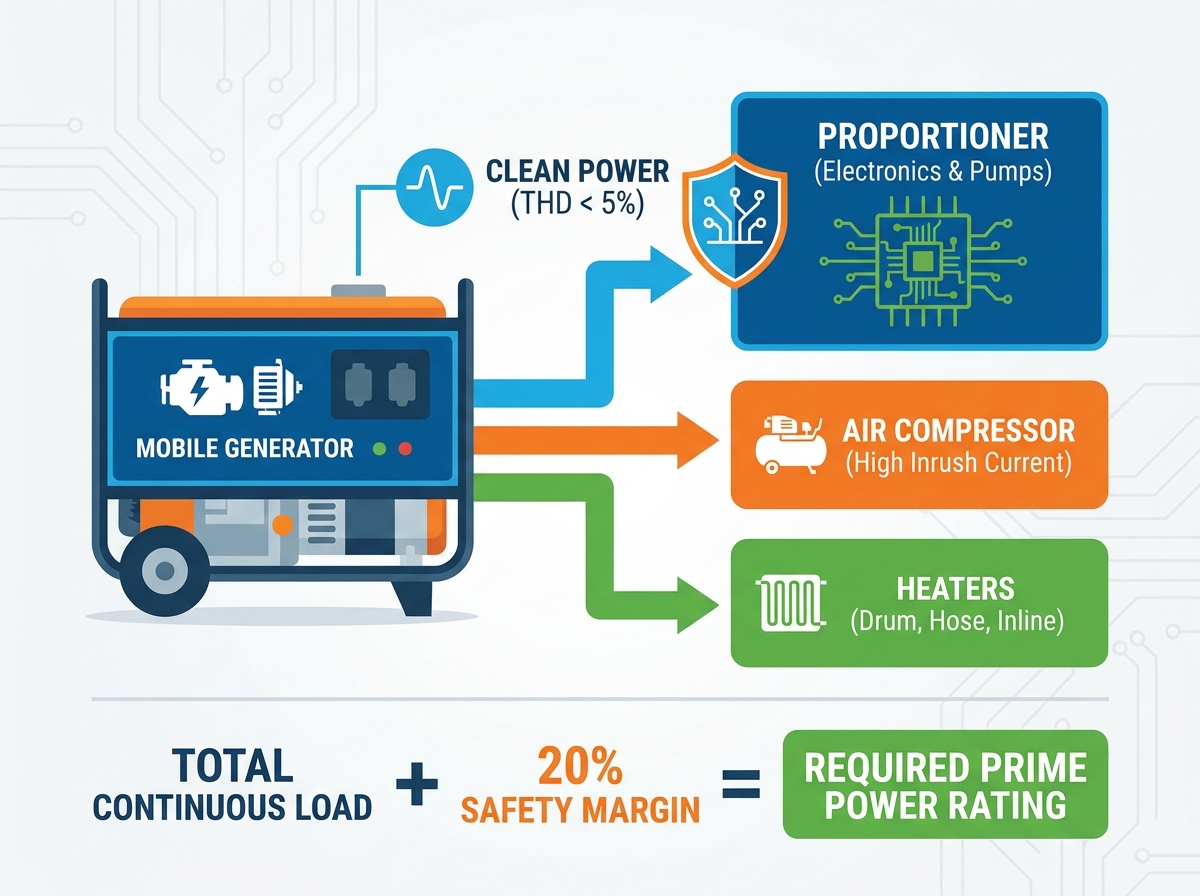
Accurate sizing prevents catastrophic mid-spray equipment shutdowns. Guessing your power needs will inevitably ruin your machinery.
You must calculate the combined wattage of every single electrical component. Add up the power demands from the proportioner and the air compressor. Include the refrigerated air dryer, drum heaters, and fresh air breathing systems. Never underestimate rig lighting and exhaust fans. A rigorous mathematical framework prevents tripping breakers.
We always follow strict continuous load parameters to guarantee reliability. Best practice dictates your continuous operating load should never exceed 80% of the generator’s rated continuous capacity. This 20% buffer absorbs unexpected environmental strains. It gives the engine breathing room when the compressor kicks on during a high-heat afternoon.
Operating environments significantly affect true electrical output. High altitude features thin air, which severely chokes engine combustion. Similarly, extreme ambient heat limits cooling efficiency. Both scenarios reduce actual power delivery by measurable percentages. You must upsize your unit if you work in high-temperature climates or mountainous regions. A 40kW unit at sea level might only produce 32kW at 5,000 feet.
You must align your electrical phases perfectly with your equipment. High-output hydraulic systems frequently demand three-phase power for maximum pump efficiency. Conversely, smaller electric proportioners usually run on standard single-phase circuits. Supplying the wrong phase guarantees immediate failure.
Let us review a typical continuous load calculation chart for a commercial rig:
Equipment Component | Estimated Power Draw (Watts) | Typical Phase Requirement |
|---|---|---|
Hydraulic Proportioner | 15,000 - 22,000 | 1-Phase / 3-Phase |
Air Compressor (5HP - 10HP) | 4,000 - 8,000 | 1-Phase / 3-Phase |
Hose Heater (Per 100ft) | 1,200 - 1,500 | 1-Phase |
Drum Heaters (Pair) | 2,000 - 3,000 | 1-Phase |
Lighting & Fresh Air System | 1,000 - 1,500 | 1-Phase |
Selecting a resilient generator set for spray foam machine applications goes far beyond checking the gross wattage.
Modern spray equipment relies heavily on sensitive microprocessor controls. These advanced circuit boards require exceptionally clean electricity. You absolutely need a brushless alternator equipped with Automatic Voltage Regulation (AVR). This technology ensures Total Harmonic Distortion (THD) remains below 5%. High THD scrambles sensor readings immediately. It fries expensive computer panels and causes erratic heating behavior.
Electric motors behave differently than simple heating elements. Air compressors pull massive inrush currents upon startup. We call this Locked Rotor Amps (LRA). A 10HP compressor demands up to three times its running wattage for a split second. Your alternator must possess the physical mass to handle this sudden surge. If it lacks robust motor starting capability, the voltage flatlines. The entire electrical system crashes instantly.
Manufacturers classify engines into distinct operational tiers. Standby ratings apply exclusively to emergency residential use. Standby units cannot survive daily eight-hour runs inside hot trailers. You must purchase units bearing prime power ratings. Prime units endure continuous, heavy-duty mobile operation without degrading prematurely. They feature better cooling channels and stronger internal bearings.
Best Practice: Always request the alternator data sheet from your dealer. Verify the surge capacity curve before signing any purchase order.
Taking off-grid polyurea equipment into remote fields demands flawless trailer integration. Poor mounting choices destroy expensive rigs.
Commercial power plants represent massive, concentrated dead weight. They frequently exceed 1,000 pounds. You must place this heavy footprint strategically relative to the trailer axles. Proper placement balances the heavy 500-pound chemical totes located nearby. Ignoring this critical weight balance causes dangerous trailer sway. At highway speeds, an unbalanced rig becomes uncontrollable.
Large engines suffocate rapidly inside enclosed trailers. They generate intense radiant heat during operation. You must design proper intake louvers based on the engine's Cubic Feet per Minute (CFM) requirements. Additionally, you need mechanical exhaust fans pulling hot air out through the roof. Without active airflow routing, the engine overheats. It will shut down completely mid-spray, leaving chemicals curing inside your hoses.
Large diesel engines shake violently under heavy load. Heavy-duty isolation mounts are completely mandatory. Without these thick neoprene dampeners, constant vibration travels directly through the trailer floor. This shaking severely weakens structural trailer welds. It also fractures sensitive chemical plumbing lines over time, causing toxic leaks.
Engines produce deadly exhaust gases. These emissions require strict, careful management. You must pipe exhaust gases far away from the operator's fresh air intake systems. Proper exhaust routing maintains OSHA safety compliance. It protects your crew from fatal carbon monoxide poisoning. Never terminate an exhaust pipe underneath the trailer floor.
To successfully integrate your power plant, follow these steps:
Calculate the exact center of gravity for your empty trailer.
Install heavy-duty steel mounting plates welded directly to the frame cross-members.
Cut intake louvers on the coolest side of the trailer box.
Route the exhaust pipe through a heat-shielded roof or wall thimble.
Test run the entire system for two hours to verify ambient internal temperatures.
Finalizing your equipment investment requires careful vetting of the vendor's aftermarket support. Never buy based solely on the lowest sticker price.
Never assume standard factory guarantees apply to custom mobile rigs. You must read the fine print carefully. Confirm the manufacturer warranty explicitly covers mobile, commercial, off-grid use. Many standard warranties become immediately voided once you bolt the unit into a mobile trailer. Ask your dealer for written confirmation regarding mobile applications.
Equipment inevitably breaks in the field. When it does, local support dictates your downtime duration. Evaluate the brand's authorized dealer footprint near your primary service areas. A robust local parts network minimizes delays. Waiting three weeks for a proprietary alternator diode kills your project timeline and damages client trust.
You face a critical choice between buying a pre-integrated rig and retrofitting an existing setup. Turnkey solutions arrive fully engineered by professionals. They feature correct ventilation, flawless phase matching, and safe weight distribution from day one. You can start spraying immediately. Conversely, DIY retrofits require intense personal labor. You must manage complex high-voltage wiring, structural steel bracing, and safety compliance yourself. While doing it yourself seems flexible initially, pre-engineered systems eliminate dangerous integration errors. Professional builds guarantee your equipment operates reliably under harsh conditions.
Your generator stands as a critical investment in job site uptime, not merely an optional accessory. A failed power plant halts every other piece of equipment you own. We strongly recommend prioritizing clean power with low THD ratings. Always insist on prime-power duty cycles designed for commercial abuse. Furthermore, strictly respect the 80% sizing margin to ensure longevity. Skipping these engineering rules leads to catastrophic equipment failures in the field. Before making a final purchase, you should thoroughly audit your specific equipment power draw. We highly encourage operators to consult with an integration specialist. They will verify your phase requirements and load profiles, ensuring your rig sprays flawlessly for years to come.
A: No. Portable home units pose massive risks to commercial spray rigs. They produce high Total Harmonic Distortion (THD). This dirty power instantly destroys sensitive proportioner control boards. Furthermore, they lack prime-power ratings for continuous eight-hour usage. Their alternators simply cannot handle the combined surge of heavy air compressors and drum heaters turning on simultaneously.
A: A baseline range typically falls between 30kW to 45kW for standard commercial rigs. However, you must calculate exact component loads. Add up your proportioner, compressor, drum heaters, hose heat, and rig lighting. Always ensure your total continuous draw stays below 80% of the unit's rated capacity to prevent tripping.
A: This happens due to severe voltage sag. When your heavy-duty air compressor starts, it draws a massive inrush current. If you have an undersized alternator or lack adequate motor-starting capability, the voltage drops sharply. The proportioner detects this starvation and triggers an error to protect its circuitry.
A: Shared diesel cells save valuable trailer floor space and reduce total rig weight. They also simplify refueling stops since you only fill one tank. However, standalone tanks make tracking specific equipment fuel consumption easier. Most commercial integration experts prefer a single, larger shared cell for logistical efficiency on the job site.


