
Views: 0 Author: Site Editor Publish Time: 2026-09-15 Origin: Site


Do you know why so many foam spray jobs fail out in the field? More often than not, the culprit is not bad chemicals or a faulty proportioner. It is a compromised air supply.
Operating a polyurethane foam spray machine efficiently requires much more than just dialing in the correct fluid temperatures. In any pneumatic setup, compressed air is the absolute lifeblood of the entire operation. Poor air pressure ruins your foam yield. It leaves you with heavy, off-ratio material that eats directly into your profit margins. Even worse, wet air will quickly destroy your expensive fluid pumps and spray guns.
As fluid engineers, we constantly see contractors blaming the proportioning pumps when the real issue is air starvation. In this comprehensive guide, we will break down the exact air specifications needed to run your equipment flawlessly. From understanding the delicate balance of air volume and pressure to mastering moisture control, you will learn how to protect your equipment investment and maximize your daily output.
Volume is King: Most pneumatic spray systems require a minimum of 15 to 25 Cubic Feet per Minute to sustain continuous, uninterrupted pumping action.
Consistent Pressure: A stable dynamic working pressure of 100 to 130 Pounds per Square Inch is strictly required to guarantee proper fluid atomization and reliable motor stroking.
Air Quality is Non-Negotiable: Ambient atmospheric moisture is the primary enemy of isocyanate. Utilizing refrigerated air dryers and multi-stage water separators is mandatory.
Compressor Selection: For heavy-duty commercial applications, rotary screw air compressors are vastly superior to standard reciprocating models due to their continuous duty cycle capabilities.
To truly master your equipment, you must first understand that pneumatic systems operate on fundamentally different principles than hydraulic or electric alternatives. Compressed air is responsible for executing multiple critical functions simultaneously. If the air generation source falters, the entire application process collapses immediately.
The heaviest burden placed on your compressor is powering the main air motor. This motor drives the fluid proportioning pumps. These pumps physically draw the A-side Isocyanate and B-side Resin chemicals from their drums, push them through the primary heaters, and pressurize them inside the hose bundle.
This system relies heavily on a multiplier principle. A large air cylinder utilizes a relatively low air pressure, such as 100 PSI, to generate exceptionally high fluid pressures ranging from 1000 to 2000 PSI. Imagine standing on a scaffold, spraying continuously. If your air supply fluctuates or drops even slightly, the fluid pressure instantly plummets. This creates an immediate imbalance between the A and B chemicals. The result? Off-ratio foam that shrinks, fails to cure, or completely lacks structural integrity.
Moving beyond the main proportioner, compressed air travels down the entire length of your heated hose bundle directly to the spray gun. Inside the gun block, high-velocity air assists in the impingement mixing process. It violently forces the two chemicals to atomize into a fine, uniform mist just milliseconds before hitting the substrate.
Specifically, pneumatic spray guns rely entirely on an air-purge mechanism to prevent catastrophic clogs. The exact moment you release the trigger, a sharp blast of compressed air clears the mixing chamber. If your dynamic pressure is too low during this phase, residual mixed foam remains inside the chamber and cures instantly. What follows is a frustrating, time-consuming manual rebuild of the gun right in the middle of a job.
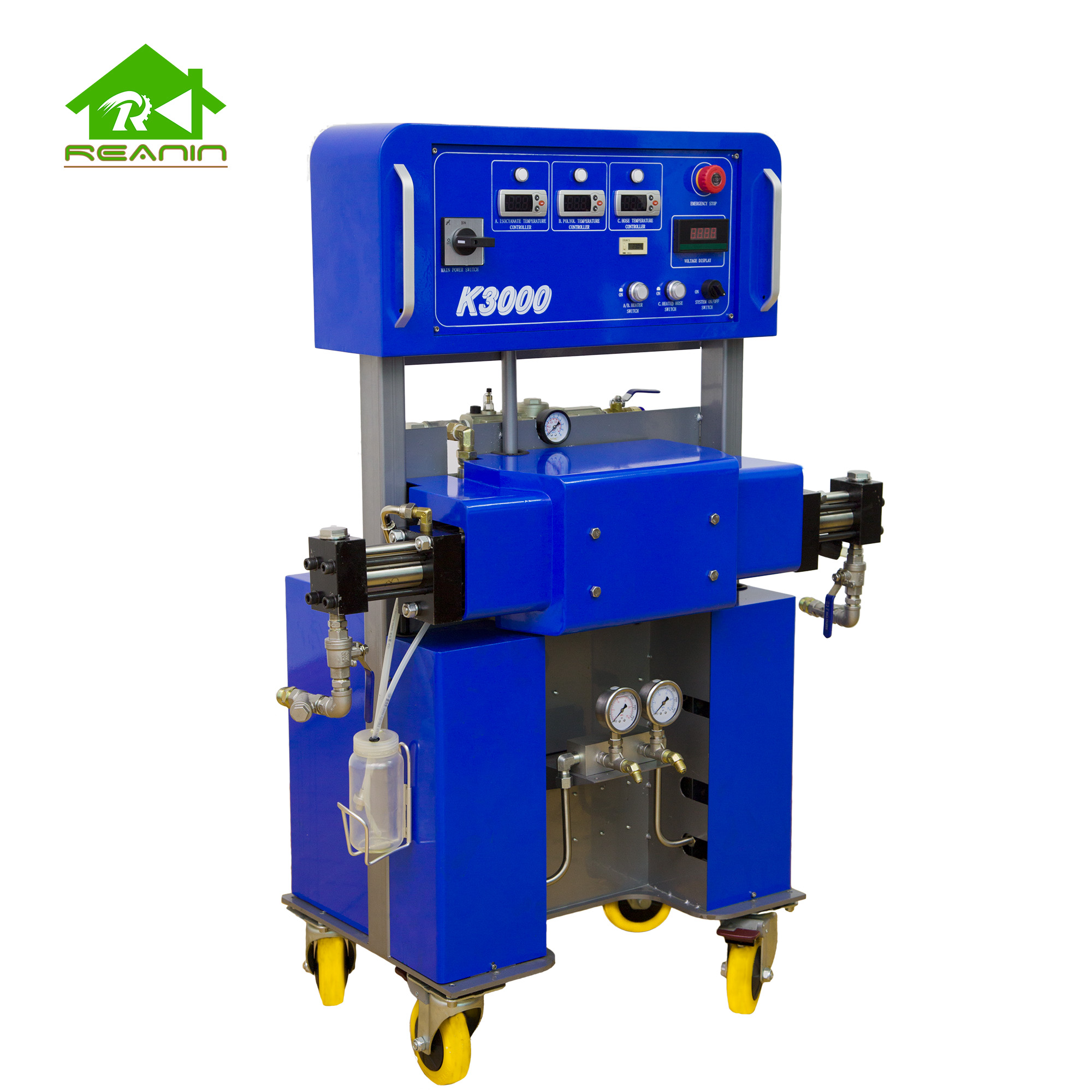
Selecting the right air compressor involves calculating the precise volumetric demands of your specific equipment. Relying on guesswork or attempting to save capital with an undersized unit will inevitably lead to operational bottlenecks. The two metrics you must evaluate carefully are CFM and PSI.
To make selection easier, we have compiled a standard reference table based on frontline engineering data. This highlights the required air supply for different classes of equipment.
Equipment Class | CFM Requirement | Dynamic PSI | Ideal Compressor Type |
|---|---|---|---|
Residential / Light Commercial | 15 - 20 CFM | 100 - 120 PSI | Gas-Powered Reciprocating |
Heavy Commercial / Roofing | 25 - 35+ CFM | 100 - 130 PSI | Rotary Screw Compressor |
Let us look at a real-world example. A high-performance pneumatic polyurethane foaming machine like the Reanin K3000 is designed to handle maximum fluid working pressures up to 2000 PSI. To maintain this immense fluid pressure, the machine's air motor demands a rock-solid dynamic air pressure of 100 to 120 PSI. If your air compressor cannot deliver the necessary volume of air, the pumps will stall out mid-stroke.
Contractors who attempt to cut corners by purchasing an undersized compressor face severe frustrations daily. The immediate symptom is a sputtering, uneven spray pattern. As the compressor struggles to keep up, it runs continuously past its intended duty cycle. For a standard reciprocating compressor, this leads to extreme overheating, excessive oil blow-by into the air lines, and ultimately, premature engine failure.
Looking at recent developments in the global insulation sector, there is a massive shift in how contractors handle air supply. Commercial operators are increasingly moving away from traditional piston compressors. Instead, they are investing heavily in variable-speed rotary screw units equipped with smart air monitoring sensors.
Why is this happening? Raw chemical costs continue to rise globally. The margin for error on a job site has shrunk dramatically. Modern pneumatic setups are now evaluated not just on raw power, but on their ability to deliver a perfectly stable dynamic pressure without fluctuation. This stability directly translates to maximized chemical yield and significantly reduced material waste. Furthermore, stricter environmental regulations are pushing contractors toward more energy-efficient air generation methods.
Delivering the correct volume and pressure is only half the battle. The actual quality of the air is equally vital. Ambient air naturally contains humidity. When a compressor pressurizes that air, it concentrates the moisture. If left untreated, this water travels directly into your delicate pneumatic system.
Moisture is the absolute worst enemy of spray foam chemicals. When the A-side chemical Isocyanate is exposed to water, it does not just degrade. It reacts violently. Instead of forming expanding foam, it crystallizes into a hard, abrasive, urea-like substance. It feels exactly like sand in your gears.
If moisture-laden air enters the fluid system, these crystals will quickly score pump seals, clog heated hoses, and destroy the gun's mixing chamber. Additionally, oil blow-by from a poorly maintained compressor can be disastrous. If microscopic oil particles mix with the atomized foam at the gun tip, the oil acts as a release agent. This severely compromises the adhesion of the foam to the substrate. This is a critical failure point when applying materials with a closed cell foam spray machine designed for structural reinforcement and strict vapor barriers.
To protect your rig and ensure optimal yield, integrating proper air treatment components is an absolute necessity.
Refrigerated Air Dryers: This is the gold standard for spray foam rigs. A refrigerated dryer cools the compressed air to approximately 38 degrees Fahrenheit, forcing suspended water vapor to condense into liquid, which is then automatically drained.
Desiccant Dryers: For operators working in extremely humid, coastal, or tropical environments, a desiccant dryer might be required. These units use chemical beads to absorb moisture, lowering the dew point to bone-dry levels.
Water and Oil Separators: Before the air reaches the proportioner, it must pass through a multi-stage filtration system. This typically includes a particulate filter for dust and a coalescing filter to trap oil aerosols.
Not all spray foam equipment is built with the same architecture. Your air supply must be carefully matched to the specific class of machine you are operating to avoid wasted fuel or continuous stalling.
A portable PU foam spray machine, such as the Reanin K2000, is engineered specifically for mobility. These units are frequently deployed for residential attic insulation, rim joists, or concrete lifting. Because they are designed to be moved easily, they feature highly efficient air motors that require less air volume, usually in the 15 to 20 CFM range.
However, being portable does not mean you can compromise on air quality. Even small, mobile setups demand strictly regulated, dry air. Contractors using portable rigs often pair them with high-end, gas-powered reciprocating compressors mounted on vibration-dampening pads, combined with compact inline moisture separators.
On the opposite end of the spectrum are heavy-duty systems built for high-volume, continuous output. Applications such as commercial flat roofing, large-scale cold storage, and geotechnical void filling require a true construction polyurethane injection machine.
These units utilize massive air motors to push thick, high-viscosity materials over long hose lengths that sometimes exceed 300 feet. To keep up with this intense demand, operators must employ large rotary screw compressors. Rotary screw compressors are the preferred choice here because they offer a continuous duty cycle. They can run all day without experiencing thermal shutdown or pressure degradation.
The journey of the compressed air from the storage tank to the proportioning machine involves several critical checkpoints. Proper sizing of these delivery components prevents friction loss and protects the machine's internal pneumatics.
A remarkably common mistake made by new contractors is using air hoses that are too narrow. As air travels through a hose, friction against the inner walls causes a drop in pressure. The longer the hose and the narrower the diameter, the more severe the friction loss.
For pneumatic polyurethane systems, standard quarter-inch or three-eighths-inch air hoses are generally insufficient for the main supply line. It is highly recommended to use at least a half-inch or three-quarter-inch inner diameter air hose to connect the compressor to the machine. This ensures that the high volume of air required reaches the motor without being choked out.
Just before the compressed air enters the machine's air motor, it must pass through an FRL unit. This is your final line of defense.
The filter acts as the last barrier against any remaining particulates or liquid moisture that bypassed the main dryer. The regulator allows the operator to dial in the exact dynamic working pressure required to balance the A and B chemical pumps perfectly. Finally, the lubricator injects a microscopic mist of pneumatic oil into the air stream to lubricate the internal seals and pistons of the air motor.
There is a crucial setup rule you must follow. It is absolutely imperative that the air traveling to the spray gun bypasses the lubricator. You must only lubricate the air going to the machine's motor. If pneumatic oil reaches the gun's air supply, it will contaminate the foam and destroy substrate adhesion.
Even with a meticulously designed setup, operators will occasionally encounter pneumatic anomalies on the job site. Diagnosing these issues quickly through systematic isolation is necessary to minimize downtime.
If your machine starts at 120 PSI, but after thirty seconds of spraying, the pressure steadily drops to 80 PSI, your spray pattern will narrow. You are experiencing a volumetric deficit. The machine is simply consuming air faster than the compressor can replenish it.
To fix this, first verify that all air hoses are at least a half-inch inner diameter and that there are no restrictive quick-disconnect fittings. If the plumbing is correct, you may need to install an auxiliary air receiver tank near the proportioner to provide a larger buffer of stored air. Ultimately, you might need to upgrade to a compressor with a higher CFM rating.
If the foam looks chunky, fails to expand to its expected yield, or begins to shrink and pull away from the studs after a few minutes, you likely have an air issue at the gun. This is a classic sign of poor impingement mixing caused by inadequate dynamic air pressure, or moisture contamination reacting prematurely with the Isocyanate.
Check the air regulator dedicated to the gun and ensure the pressure is holding steady above 100 PSI while the trigger is pulled. Next, inspect your water separators. If water is present in the lines, your refrigerated air dryer requires immediate servicing.
The longevity and reliability of your equipment are inextricably linked to the maintenance of its air supply system. Implementing a strict preventative maintenance protocol is the most effective method for avoiding catastrophic equipment failure.
Before beginning any spray job, operators should perform routine daily checks. The most critical task is draining the air compressor tank. Compressing ambient air naturally concentrates atmospheric humidity into liquid water inside the primary receiver tank. Open the drain valve at the bottom of the tank to release this accumulated water. Additionally, check the compressor oil levels, ensure the refrigerated dryer is powered on, and test the air-purge mechanism on the spray gun before introducing chemicals.
On a weekly basis, inspect the coalescing filters and water separators. These filters have a finite lifespan and will become saturated over time, which restricts airflow. Replace the filter elements according to the manufacturer's recommendations.
A pneumatic spray machine is only as reliable as the air supply driving it. Proper air volume, consistent dynamic pressure, and rigorous moisture control are the foundational pillars of high-quality foam application. By matching your compressor to your machine's exact specifications and adhering to strict maintenance protocols, you prevent daily chemical waste and protect your hardware from premature failure.
Do not let a subpar air setup ruin your profit margins. If you are looking to upgrade your rig or need equipment designed to handle demanding environments, choosing the right proportioner is critical. We highly recommend evaluating systems that match your specific project scale. For industry-leading solutions, from highly mobile residential units to heavy-duty commercial rigs, explore the advanced product lineups at chinareanin.com to find the perfect pneumatic system for your business.
No. Standard pancake or small contractor-grade reciprocating compressors are designed for low-volume pneumatic tools like nail guns. They typically generate only 2 to 5 CFM. Operating a professional proportioner requires a constant, uninterrupted flow of 15 to 35+ CFM to drive the air motor and purge the spray gun simultaneously. Using an undersized compressor results in immediate pressure drops, stalling pumps, and severely off-ratio foam.
Moisture is highly detrimental to the application process. The A-side chemical reacts violently and instantly when exposed to water, creating hard polyurea crystals and carbon dioxide gas. If moisture from the air supply enters the system, these abrasive crystals will form inside the fluid pumps, heated hoses, and the spray gun, causing irreversible scoring of the cylinders and total blockage of the lines.
For commercial and industrial applications, rotary screw compressors are vastly superior. Reciprocating piston compressors typically have a limited duty cycle, meaning they must shut down and cool off to prevent overheating. Spraying foam is a continuous process that demands a continuous duty cycle. Rotary screw compressors are engineered to run constantly under full load without overheating, providing a steady volume of air that prevents the proportioner from stalling.
Yes, the air supply directly and significantly impacts your overall foam yield. Yield is determined by how efficiently the A and B chemicals are mixed and atomized. If your air pressure is too low, the impingement mixing inside the gun chamber is compromised. The chemicals will exit the nozzle in a poorly mixed, liquid state rather than a fine mist, preventing the foam from reaching its maximum expansion potential. This results in dense, heavy foam that covers less square footage.
You should drain your air compressor tank daily, preferably at the end of every shift. When air is compressed, the ambient humidity condensates into liquid water inside the storage tank. If left undrained, this water reduces the tank's air capacity, causes internal rusting, and drastically increases the risk of moisture bypassing your air dryers and entering the chemical pumps.
For the main air supply line connecting your compressor to the proportioner, you should use an air hose with at least a half-inch or three-quarter-inch inner diameter. Using standard quarter-inch or three-eighths-inch hoses creates excessive friction loss over distance. This chokes the air volume before it even reaches the machine's motor, leading to pressure drops when you pull the trigger.


