
Views: 0 Author: Site Editor Publish Time: 2026-05-28 Origin: Site


Building energy codes are becoming strictly enforced across the globe. Standards like Net Zero Ready and Passive House now dominate modern construction discussions. Clients increasingly demand aggressive reductions in their monthly utility costs. They expect newly constructed or retrofitted buildings to perform exceptionally well under extreme weather conditions. While the chemical properties of spray foam receive much credit for this energy efficiency, a hidden variable often goes unnoticed. The equipment used for application dictates the true peak thermal performance of any project. Even superior chemical formulations fail entirely if operators apply them incorrectly.
To capitalize on high-margin, energy-efficient building projects, contractors must look far beyond the chemical formulation. You must actively evaluate how a high-quality Polyurethane Foam Spray Machine guarantees exact yield. It maintains the ideal cell structure and creates a seamless barrier. These mechanical factors ultimately deliver verifiable energy savings. We will explore how precision dictates thermal resistance, eliminates thermal bridges, and scales high-efficiency operations effectively.
We must first examine the baseline reality of energy loss. Air infiltration causes up to 40% of building energy loss. HVAC systems consume roughly 56% of household energy bills. You can easily see why property owners expect major improvements. Clients routinely want their energy bills to drop by 20% to 40% post-installation. They rely on your insulation to act as the primary defense against harsh weather.
Contractors face a massive challenge in meeting these expectations. Flawless execution remains mandatory. If your spray equipment fails to maintain consistent temperature and pressure, disasters happen. The foam will not cure correctly. This mechanical failure leads directly to off-ratio spraying. Lower R-values inevitably follow, bringing expensive callbacks and ruined reputations. You simply cannot afford spongy, shrinking foam on a job site.
We need a clear solution framing for this challenge. You are no longer merely "installing insulation" inside wall cavities. You are actively engineering high-performance building envelopes. Upgrading to a professional-grade Polyurethane Foam Spray Machine completely shifts your business model. You gain total control over the chemical reaction. You deliver consistent, airtight results every single time. This reliability builds trust and secures future high-end contracts.
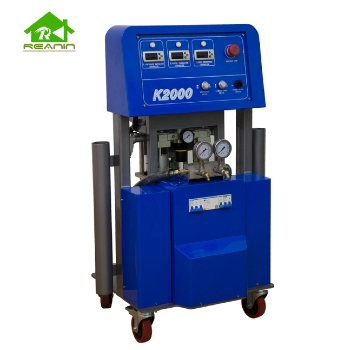
How exactly does machinery impact the final R-value? It all comes down to the mechanism of action. Primary heaters and heated hoses do the heavy lifting during application. They ensure your raw materials reach the gun at perfect viscosities. You have the A-side (Iso) and the B-side (Resin). They must mix seamlessly at the exact moment of spray. Optimal viscosity guarantees a full, robust expansion.
Next, consider open-cell versus closed-cell output requirements. Processing high-density closed-cell foam proves notoriously difficult for inferior equipment. You want to hit the standard 6.5 R-value per inch consistently. You need intense heat and sustained pressure to achieve this density. This scenario is where a dedicated Closed Cell Foam Polyurethane Spray & Injection Insulation Machine becomes essential. It maximizes structural integrity effortlessly. It applies an impermeable moisture and vapor barrier. A precision machine lets you lock in these properties without constant manual adjustments.
Eliminating thermal bridges serves as another crucial factor for energy efficiency. Traditional rigid boards often leave gaps at the edges. Steady machine pressure solves this problem immediately. It allows applicators to seamlessly seal complex geometries. You can coat rim joists effortlessly. You can bridge transitions between dissimilar building materials like wood, steel, and concrete. These materials all expand differently over time. A consistent foam application absorbs these structural shifts without cracking or breaking the air seal.
High-yield output maximizes usable space inside a building. Precise machinery allows contractors to achieve target R-values inside much thinner wall cavities. Urban developers love this specific advantage. Passive House architects consider it a major selling point. You get superior insulation without sacrificing precious interior square footage. Thinner walls mean larger living spaces, which directly increases real estate value.
Adapting to job site variables remains mandatory for growing businesses. Commercial spaces sprawl across vast areas. Residential attics present hard-to-reach, cramped corners. Equipment versatility makes or breaks your daily timeline. You might need to run over 300 feet of heated hose. You must maintain chemical temperatures across that entire distance. Exceptional machinery prevents the materials from cooling down prematurely. It keeps your crew spraying steadily instead of waiting for heaters to catch up.
Verified machine output also changes HVAC equipment sizing dynamically. Engineers monitor insulation performance closely when designing mechanical systems. Consistent machine output gives them tremendous confidence. They can often downsize heating and cooling equipment by up to 35%. This downsizing drastically improves the overall project ROI for your client.
When you provide a flawless air barrier, the HVAC downsizing benefits compound rapidly:
You need strict criteria when shortlisting equipment for high-efficiency jobs. Let us examine proportioner pump architecture first. You generally choose between pneumatic, hydraulic, and electric pumps. Hydraulic and electric pumps offer sustained pressure. You desperately need this stability for large, continuous high-efficiency jobs. Pneumatic pumps work well for smaller tasks, but they often struggle to maintain pressure during rapid, prolonged spraying.
Heating capacity, often called Delta T, matters immensely. Your machine must heat cold chemicals to optimal spraying temperatures rapidly. This function proves essential for cold-climate applications. Energy efficiency upgrades are most critical in freezing regions. If the machine cannot maintain a high Delta T, you will spray poorly mixed foam.
Pressure uniformity ensures a quality cure. Pressure imbalances create soft, "spongy" foam. Spongy foam completely fails to air-seal a space. It also ruins your material yield, shrinking your profit margins. Eliminating pressure drops ensures strict adherence to manufacturer chemical yield specifications.
Modern equipment features robust data logging capabilities. These digital tools track spray ratios and temperatures in real-time. They provide verifiable proof of correct application. Strict building inspectors love this transparent data. Energy rebate programs often require it to approve homeowner tax credits.
| Pump Type | Pressure Stability | Ideal Application Scale | Maintenance Complexity |
|---|---|---|---|
| Pneumatic | Moderate (can drop during heavy use) | Small residential, touch-ups | Low |
| Electric | High (consistent delivery) | Medium to large residential | Medium |
| Hydraulic | Very High (sustained power) | Large commercial, high-volume | High |
| Delta T Capacity | Fluid Temperature Maintenance | Resulting Cell Structure | Air Seal Integrity |
|---|---|---|---|
| Low (Under-powered) | Fluctuates over long hose runs | Spongy, inconsistent | High risk of leaks |
| Optimal (Pro-grade) | Stable across 300+ feet | Rigid, uniform | 100% gapless barrier |
We must address industry skepticism head-on to build trust. The "moisture migration" risk worries many builders and architects. Poorly mixed foam leaves microscopic gaps. It may fail to cure completely inside the cavity. This failure traps moisture against roof decks. Humid climates see this structural issue frequently. Precise machinery essentially eliminates this variable. A perfect 1:1 mix creates a rigid barrier. It repels bulk water effectively and stops vapor transmission dead in its tracks.
You still need highly skilled operators. Even the most advanced machine requires intelligent, daily calibration. Operator training dictates long-term project success. You must clean the Y-strainers daily. You must perform routine fluid checks before turning on the primary heaters. Proper setup avoids crossed hoses. It prevents catastrophic cold spots in the line. Daily maintenance keeps energy-efficiency standards high over the equipment's lifespan. Never ignore basic machine hygiene.
A structured routine prevents these failures. A properly maintained machine will consistently produce foam that hits its maximum rated R-value. This consistency transforms a standard contracting business into a premium energy-efficiency partner.
Building energy efficiency depends heavily on mechanical precision. A top-tier spray machine is not just a basic applicator tool. It acts as the primary quality-control mechanism for the entire building envelope. When the mechanical mix is flawless, the building performs perfectly. Contractors and facility managers evaluating their next equipment purchase should follow these action-oriented next steps:
A: A high-quality machine maintains a precise 1:1 chemical ratio and optimal fluid temperature. This mechanical control ensures the foam cures correctly. It helps the material reach its maximum rated R-value and creates a true, gapless air seal.
A: No. Closed-cell applications require much higher, more consistent pressure. They also demand robust heating capabilities. You generally find these specific features only in a specialized Closed Cell Foam Polyurethane Spray & Injection Insulation Machine.
A: Proper application guarantees a seamless thermal and air barrier. It significantly reduces the building's overall thermal load. This reduction allows HVAC systems to operate much more efficiently, often enabling engineers to downsize cooling equipment by up to 35%.
A: ROI accelerates rapidly through exact chemical yield, which means less wasted material. You also experience faster job completion. Upgraded equipment gives you the verifiable data needed to qualify for premium-priced Net Zero and Energy Star compliant contracts.


