
Views: 0 Author: Site Editor Publish Time: 2026-04-26 Origin: Site


Utility costs are climbing rapidly across the globe. Property owners feel this financial strain every single month. The Department of Energy highlights a startling fact about this issue. Nearly half of a building's energy consumption goes directly toward heating and cooling. Traditional insulation attempts to fix this problem. It addresses conductive heat loss through thermal resistance, known as R-value. However, traditional materials fail to stop convective heat loss. Unregulated air leakage accounts for up to 40% of energy waste. Polyurethane (PU) spray foam solves this massive inefficiency. It provides a measurable reduction in heating and cooling costs. It combines high thermal resistance with an impermeable air seal. You cannot achieve these results automatically. They rely entirely on precise chemical application. Contractors must control temperatures and pressures perfectly. Without this precision, the foam will fail to insulate. Professional-grade equipment becomes just as important as the material itself.
Dual-Action Efficiency: PU spray foam acts as both an insulator (up to R-7 per inch) and an air barrier, directly lowering monthly energy bills by 20% to 40%.
HVAC Downsizing: Perfect air sealing reduces mechanical load, allowing property owners to install smaller, less expensive HVAC systems (up to 35% capacity reduction).
Equipment Dependency: Achieving advertised R-values and maximum chemical yield requires consistent heat and pressure control, only achievable with a dedicated Polyurethane Foam Spray Machine.
Verifiable ROI: Initial installation costs are offset by long-term bill reduction, property tax credits (e.g., IRA subsidies), and extended material lifespan.
Air does not stay still inside a building. It moves constantly due to temperature and pressure differences. This movement creates the "stack effect". Warm air naturally rises toward the attic. Unregulated air exchange draws this conditioned air out through the roof. At the same time, this upward draft creates negative pressure below. It pulls unconditioned exterior air in through basements and crawlspaces. You pay money to heat or cool your indoor air. The stack effect steals it immediately. Stopping this cycle requires more than just thick material. You need a continuous physical barrier.
Traditional materials struggle against convective heat loss. Standard fiberglass or cellulose offers an R-value around 2.9 per inch. They perform decently in a sterile laboratory environment. Real-world applications tell a different story. These materials degrade over time. They sag inside vertical wall cavities. This sagging creates open gaps at the top of the walls. Air passes right through these unprotected spaces. Fiberglass also absorbs ambient humidity. Trapped moisture reduces its overall thermal efficiency dramatically. It becomes heavy, compresses further, and loses its insulating properties. Traditional materials simply cannot stop drafts on their own.
Polyurethane foam offers a massive one-step application advantage. Installers spray it as a hot liquid. It expands rapidly within seconds. It chemically bonds to edge joists, wall cavities, and roof decks. This expansion fills every tiny crack and crevice. Wood framing naturally conducts heat from inside to outside. We call this thermal bridging. PU foam expands over these studs to neutralize thermal bridging completely. You get a monolithic seal across the entire building envelope. You do not even need secondary vapor barriers. It stops air and heat transfer simultaneously.
Building owners demand proof before investing in premium materials. Third-party benchmarks confirm these massive energy savings. Oak Ridge National Laboratory (ORNL) conducted extensive research on building envelopes. Their findings show impressive results for closed-cell foam applications. You can achieve up to 30% savings on winter heating costs. Summer cooling costs can drop by an additional 20%. These numbers assume proper installation and whole-home sealing. When you stop conditioned air from escaping, your mechanical systems run far less frequently. The monthly utility bill reflects this reduced runtime immediately.
The financial benefit goes far beyond monthly utility bills. Consider the initial equipment costs for mechanical heating and cooling. A highly sealed building envelope lowers the necessary mechanical load. You require significantly less tonnage to condition the space. Perfect air sealing reduces mechanical load substantially. Property owners can install smaller, less expensive HVAC systems. You can often see up to a 35% capacity reduction in equipment size. This significantly reduces upfront capital expenditure. It shifts your budget from mechanical hardware into a permanent building envelope upgrade.
Modern building codes push for extreme energy efficiency. High-performance standards demand better building materials. PU foam aligns perfectly with Energy Star compliance guidelines. It helps builders meet rigorous Net Zero building codes easily. Net Zero buildings produce as much energy as they consume. You cannot reach this benchmark using leaky fiberglass batts. You must seal the envelope tightly first. Spray foam acts as the foundational step for these advanced building standards. It makes solar panels and heat pumps much more effective.
Contractors use two distinct types of spray foam. You must choose the right formulation for your specific project. Both provide excellent air sealing, but their physical properties differ greatly.
Feature | Open-Cell Foam | Closed-Cell Foam |
|---|---|---|
R-Value (per inch) | ~3.5 to 3.8 | ~6.5 to 7.0 |
Expansion Rate | Up to 100x | 30x to 40x |
Density | 0.5 lbs per cubic foot | 2.0 lbs per cubic foot |
Moisture Permeability | Permeable (breathes) | Impermeable (acts as vapor barrier) |
Primary Use Case | Interior walls, soundproofing | Exterior walls, extreme climates, below-grade |
Open-cell foam features a soft, sponge-like structure. Its cells remain intentionally broken or "open". It expands up to 100 times its original liquid volume. This massive expansion makes it highly cost-effective for deep wall cavities. It offers excellent sound dampening capabilities for interior partitions. The energy profile sits at an R-value of 3.5 to 3.8 per inch. It works best for interior walls and complex roof pitches. You must handle moisture control externally, as open-cell foam allows water vapor to pass through.
Closed-cell foam features a dense, rigid physical structure. Its cells press tightly together during chemical curing. It adds significant racking strength to exterior walls. It acts as a total vapor barrier against humidity. The energy profile boasts a premium R-value of 6.5 to 7.0 per inch. It packs maximum insulating power into shallow framing spaces. It remains ideal for extreme climates and external metal buildings. You also use it exclusively for below-grade basement applications where moisture contact is guaranteed.
You must guide your decision using clear environmental and financial parameters. Follow these specific criteria:
Evaluate Climate Zones: Hot, humid climates require vapor barriers. Closed-cell foam prevents moist exterior air from condensing inside cool walls.
Assess Budget Constraints: Open-cell foam costs less per board foot. It stretches limited budgets while still providing an effective air seal.
Review Building Code Moisture Requirements: Check local regulations regarding vapor retarders. Below-grade applications always demand closed-cell foam to meet code safely.
The spray foam industry holds a dirty secret. Buying premium chemical drums does not guarantee high R-values. The raw liquid is only half the equation. The foam must be mixed at precise 1:1 ratios. Installers must maintain specific temperatures for both the A-side (Isocyanate) and B-side (Resin). The chemicals will not react properly without this heat. You lose maximum chemical yield instantly. Poor mixing leaves you with less expanded foam than you paid for. The final product might shrink, pull away from studs, or off-gas unpleasant odors.
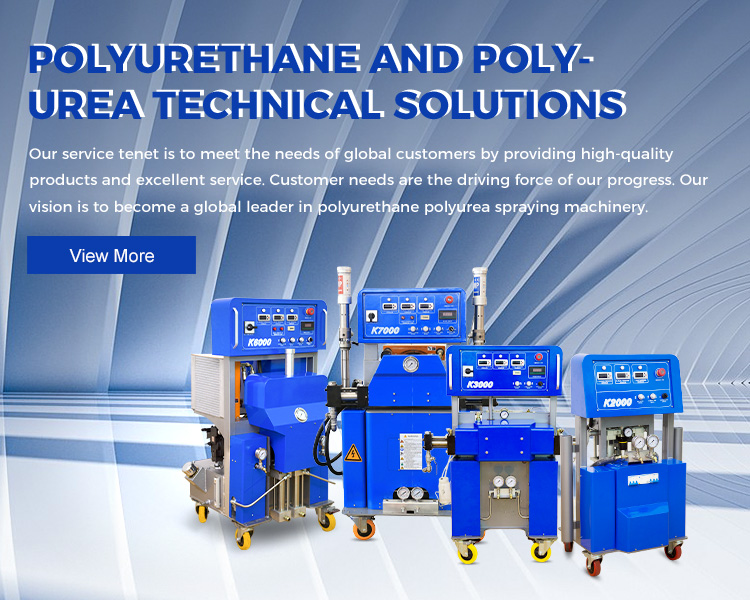
Equipment capabilities serve as the critical variable for success. You cannot achieve a perfect envelope with substandard gear. A dedicated Polyurethane Foam Spray Machine ensures precise chemical delivery. Professional proportioners maintain accurate primary heating and hose temperatures. They keep dynamic pressure perfectly balanced between both fluid lines. This technology prevents off-ratio spraying automatically. It eliminates expensive material waste on the job site. It prevents the creation of "spongy" foam that fails to insulate or structuralize the wall. High-quality equipment guarantees the foam performs exactly as the manufacturer intended.
Contractors must view their proportioners as a direct investment in business scalability. Reliable machines prevent costly callbacks to fix bad foam. Fixing bad foam requires scraping it out by hand. This ruins profitability completely. Advanced machinery maximizes your board-foot yield per drum. You get more sprayable material out of every chemical set. You ensure consistent client ROI on every single project. When you deliver perfect R-values, your reputation grows. A dependable proportioner turns chemical drums into highly profitable, predictable energy solutions.
A perfectly sealed home introduces a new environmental challenge. You trap everything inside the envelope. This directly impacts indoor air quality. Dust, cooking odors, and natural moisture cannot escape through the walls anymore. You must pair spray foam with mechanical ventilation. Building science dictates this crucial step. You cannot technically "over-insulate" a house, but you can definitely under-ventilate it. We highly recommend installing Heat Recovery Ventilators (HRV) or Energy Recovery Ventilators (ERV). They exhaust stale indoor air while drawing in fresh exterior air. They exchange the thermal energy during this process, preserving your heating and cooling savings.
You should never guess about energy efficiency improvements. You need to prove the results scientifically. We recommend conducting pre- and post-installation Blower Door Tests. A technician installs a powerful fan in your front door. It depressurizes the house to measure exactly how much air leaks in through the framing. This test quantifies the Air Changes per Hour (ACH) improvement. A standard older home might test at 7.0 ACH. A home sealed with closed-cell foam can drop below 2.0 ACH. This metric proves your insulation investment is actually working.
Spray foam carries a higher initial price tag than fiberglass batts. However, you can offset these initial costs rapidly. Government programs want you to upgrade your building envelope. Highlight current financial incentives in your region. The US Inflation Reduction Act (IRA) provides massive benefits for property owners. It offers up to $3,200 in tax credits for qualifying energy-efficient home insulation upgrades. These generous tax credits remain valid through 2032. You combine these immediate tax rebates with your monthly utility bill reductions. The payback period shortens significantly.
Polyurethane spray foam transforms building efficiency fundamentally. It stops conductive heat loss and convective air leakage in one application. It requires a higher upfront investment compared to traditional batt insulation. However, the long-term math heavily favors the foam. You realize combined savings from drastically reduced utility bills. You gain the ability to downsize your expensive HVAC equipment. You can leverage lucrative property tax incentives. These factors make it financially justifiable for long-term real estate holds. End-users should consult local contractors who utilize verifiable Blower Door testing. Contractors and applicators must evaluate their current equipment setup. They should invest in a professional Polyurethane Foam Spray Machine. Reliable proportioners ensure you deliver maximum yield, perfect air seals, and true energy efficiency to your clients.
A: It typically takes 3 to 5 years to see a full return on investment. This timeline depends on local climate extremes and local utility rates. It also depends on whether your installation qualified for government tax rebates. The monthly energy savings continue accumulating long after the payback period ends.
A: You cannot technically over-insulate a home regarding R-value. However, you can under-ventilate it. Spray foam creates a highly air-tight envelope. These sealed homes must integrate mechanical ventilation. Systems like ERVs or HRVs manage internal moisture and maintain healthy indoor air quality.
A: Closed-cell foam experiences a very minor initial drop as the chemical blowing agents cure. It quickly stabilizes at a high R-value around 6.5 per inch. It will not settle, sag, or degrade. It maintains its performance for the entire lifespan of the building, unlike traditional fiberglass batts.


