
Views: 0 Author: Site Editor Publish Time: 2026-04-23 Origin: Site


Cold chain logistics operate under incredibly high stakes. Even minor temperature fluctuations directly lead to spoiled inventory, severe regulatory fines, and massive energy waste. Facility operators face a constant battle against the elements.
The core challenge is not just about choosing an insulation material possessing a high R-value. True success requires creating an unbroken, 24/7/365 building envelope preventing all thermodynamic air exchange. If your facility leaks air, it bleeds money.
Polyurethane (PU) foam stands as the modern industry standard for commercial cold storage. However, its ultimate effectiveness depends heavily on specific application methods. You will soon see how joining standard panels compares against seamless application using a professional Polyurethane Foam Spray Machine. We will explore material comparisons, installation realities, and equipment selection to guide your next facility upgrade.
Unmatched Thermal Efficiency: Closed-cell PU foam offers the highest insulation-to-thickness ratio, routinely achieving R-32 at a 4-inch thickness.
Vapor Barrier Integrity: Unlike traditional materials, spray-applied PU foam expands to seal seams, corners, and panel joints, eliminating condensation and frost build-up.
Application Method Matters: Relying solely on pre-fabricated panels leaves vulnerable joints; utilizing a polyurethane foam spray machine ensures a monolithic, airtight seal.
Engineering Realities: Long-term success requires strict adherence to installation protocols, including under-floor heating (to prevent frost heave) and phased pull-down schedules.
Air exchange principles dictate the survival of any cold storage facility. When cold air leaks out, warm, moist air immediately replaces it. This relentless thermodynamic cycle introduces significant moisture into the controlled environment. Moisture quickly condenses and freezes on evaporator coils. Evaporator icing forces the refrigeration system into frequent, aggressive defrost cycles. These cycles consume exponential amounts of energy and drastically shorten equipment lifespans.
Many operators rely on standard prefabricated sandwich panels. These panels offer excellent insulation across their flat surfaces. However, they frequently fail at the transitions. Wall-to-roof joints, wall-to-floor connections, and sharp corners represent massive vulnerabilities. If installation teams do not seal these transitions perfectly, structural shifting will eventually open tiny gaps. Even a millimeter gap invites severe thermal leakage.
Traditional panels often use hard wooden or metallic rails along their edges. These hard rails create thermal bridges and resist natural building shifts. Substituting hard rails for flexible PU edges—known as a "soft nose" design—mitigates joint failure. Better yet, employing a foam-in-place solution completely eliminates the joint itself. Spraying polyurethane directly into gaps creates a monolithic barrier. The foam expands, absorbs structural shifting, and guarantees seamless vapor protection.
Cold chain facilities require insulation boasting a closed-cell content exceeding 90%. Open-cell materials allow water vapor to penetrate the insulation matrix. Once moisture enters and freezes, the material expands and destroys the insulation structure. High closed-cell rates ensure the foam actively resists moisture absorption. This maintains structural integrity across decades of continuous operation.
Expanded Polystyrene (EPS) remains a common, budget-friendly option. It is lightweight and easy to handle. However, EPS presents severe limitations in deep-freeze environments. When temperatures drop to ultra-low ranges between -40°C and -50°C, EPS becomes highly susceptible to structural degradation. The material turns brittle. It cannot withstand the micro-vibrations of heavy forklift traffic or natural thermal contraction.
Rockwool offers exceptional fire-resistant properties. Many builders prefer it for compliance in high-risk zones. Yet, Rockwool fails entirely in humid cold-chain environments. It acts like a sponge. Once Rockwool accumulates moisture, it loses its thermal resistance completely. In a cold room, wet Rockwool freezes into a solid block of ice, rendering it useless as an insulator.
Polyurethane foam balances thermal resistance and physical durability perfectly. For standard walls, mid-density PU foam (40–60 kg/m³) provides optimal insulation. For flooring, high-density PU foam (>60 kg/m³) becomes essential. High-density PU delivers the load-bearing strength necessary to support heavy racking systems and continuous forklift operations. It achieves this while maintaining superior thermal properties.
Material | Thermal Resistance (R-Value per inch) | Moisture Resistance | Extreme Cold Durability (-40°C) | Structural Load Bearing |
|---|---|---|---|---|
PU Foam (Closed-Cell) | 6.0 - 7.0 | Excellent (>90% closed-cell) | High (Maintains flexibility) | High (Density dependent) |
EPS | 3.6 - 4.2 | Moderate | Low (Becomes brittle) | Moderate |
Rockwool | 3.0 - 3.3 | Poor (Absorbs water) | Moderate (If dry) | Low |
Manual sealing methods simply cannot handle the complexities of a commercial cold room. Tape, caulk, and mastic degrade quickly under extreme temperature fluctuations. Conduit penetrations, pipe brackets, and irregular roof geometries create difficult "nooks and crannies." Foam-in-place technology expands to fill these exact shapes. It locks out air completely, making it mandatory for complex geometries.
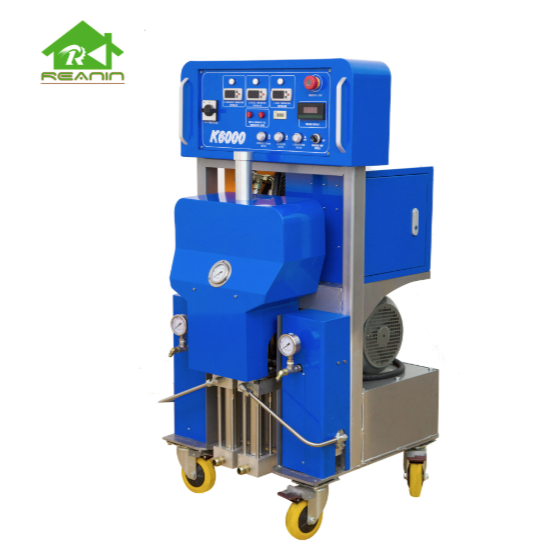
Achieving the perfect foam structure requires absolute chemical precision. A commercial-grade Polyurethane Foam Spray Machine guarantees this accuracy. The equipment precisely controls the chemical ratio of polyol to isocyanate. It also maintains strict temperature parameters at the spray gun. This precision ensures you achieve the exact 32–48 kg/m³ spray density required for optimal cold room performance. Poorly mixed foam shrinks, cracks, and fails.
Cold storage facilities endure heavy daily abuse. Forklifts dent panels. Pallets scrape walls. Keeping a reliable spray foam system on hand allows maintenance teams to execute immediate repairs. Technicians can spot-spray compromised seals instantly. This proactive approach prevents minor thermal leaks from escalating into major facility failures.
Operators must actively prevent frost heave. When you install deep-freeze rooms over a concrete slab, the extreme cold inevitably penetrates downward. It eventually freezes the sub-soil. Freezing soil expands forcefully. This expansion will easily crack the concrete slab and destroy the facility floor. To prevent this, engineers mandate installing under-floor ventilation or heated glycol pipes directly beneath the PU insulation layer. This keeps the sub-soil above freezing temperatures.
You cannot simply turn on the refrigeration system and drop the room to -30°C immediately. Lowering the facility temperature too rapidly causes severe thermal shock. The sudden contraction traps moisture inside the materials and places immense structural stress on the foam. A phased temperature reduction plan—known as a pull-down schedule—is critical.
Phase | Duration | Target Temperature Range | Objective |
|---|---|---|---|
Phase 1 | Days 1-2 | Ambient down to 10°C | Gradual structural acclimation; initial moisture removal. |
Phase 2 | Days 3-5 | 10°C down to 2°C | Slower contraction rate; deep moisture extraction via evaporators. |
Phase 3 | Days 6-7 | 2°C down to -10°C | Safe transition through the freezing point. |
Phase 4 | Days 8-10 | -10°C to Final Target (-25°C) | Final stabilization of PU foam and facility envelope. |
Modern building codes strictly regulate cold storage insulation. You must verify the PU foam system meets UL Class 1 fire ratings. Additionally, environmental regulations have evolved. You must utilize eco-friendly blowing agents boasting a Global Warming Potential (GWP) of 1. Modern formulations using cyclopentane or HFOs comply with stringent EPA and SNAP regulations. Ignoring these standards risks project shutdown and severe legal penalties.
Buyers frequently make the mistake of evaluating suppliers solely on stated material R-values. Real-world performance relies on total system support. A high R-value means nothing if the application equipment fails mid-project. Advise your procurement team to look holistically at the vendor's ecosystem.
Investing in application equipment requires careful scrutiny. A high-quality Polyurethane Foam Spray Machine must feature advanced pressure controls to prevent chemical crossover. Look for precise heating blocks ensuring the material reaches the gun at optimal viscosity. Furthermore, demand ergonomic spray guns. Operators frequently spend hours spraying overhead warehouse ceilings. Heavy, poorly balanced guns cause operator fatigue, leading directly to sloppy application and weak seals.
Equipment breaks down. When it does, project downtime costs thousands of dollars per day. Prioritize suppliers offering robust engineering consultation before the sale. Ensure they provide extensive on-site or virtual operator training. Most importantly, secure a partner offering 24/7 equipment troubleshooting. Immediate access to technical support keeps your project moving.
PU foam stands objectively as the ideal solution for cold chain warehouse insulation. Its unmatched closed-cell thermal resistance directly combats the thermodynamic threats facing modern logistics. It provides superior structural strength and unparalleled moisture barriers compared to legacy materials like EPS or Rockwool.
However, the material's inherent success remains deeply intertwined with application quality. Relying on pre-fab panels alone invites long-term leakage. You must mandate the use of rigorous engineering protocols. Pairing expert installation with reliable polyurethane foam spray machines guarantees a leak-proof, highly efficient facility.
Take the following actionable steps to secure your cold chain infrastructure:
Audit your current facility using thermal imaging to detect hidden energy leakage at panel joints.
Ensure your structural blueprints include explicit plans for under-floor heating and phased pull-down schedules.
Consult with a qualified equipment supplier to source reliable spray technology for your next build or retrofitting project.
A: Standard cold rooms typically require foam densities between 40 and 60 kg/m³. This provides excellent insulation for standard walls. However, ultra-low temperature freezers operating near -40°C benefit significantly from densities exceeding 60 kg/m³. Higher densities offer added structural integrity, especially for flooring supporting heavy loads.
A: Yes. Spray PU foam features excellent adhesion properties. It bonds exceptionally well to various substrates. Maintenance teams frequently use it to retrofit failing joints or fill structural gaps in older EPS-paneled facilities, instantly restoring the vapor barrier.
A: When installed correctly, PU foam maintains its thermal performance for 25 to 30 years. This lifespan requires a proper vapor retarder, correct substrate preparation, and strict adherence to a phased pull-down schedule during initial commissioning.
A: Yes. Modern PU formulations utilize highly sustainable blowing agents. Chemicals like cyclopentane or Hydrofluoroolefins (HFOs) meet zero Ozone Depletion Potential (ODP) and extremely low Global Warming Potential (GWP) regulatory standards, fully complying with EPA guidelines.


