
English
Views: 0 Author: Site Editor Publish Time: 2026-08-24 Origin: Site


Inconsistent open-cell foam texture directly translates to yield loss, compromised acoustic and thermal performance, and expensive tear-outs on the job site. Unlike rigid closed-cell applications, open-cell polyurethane foam is highly volatile. It reacts sensitively to minute fluctuations in temperature, pressure, and chemical ratio. Achieving the correct low-density, sponge-like texture requires precise mechanical intervention and environmental compensation from your equipment. Understanding the exact mechanisms a proportioner uses to manipulate impingement mixing, delta-T, and dynamic pressure separates profitable jobs from disastrous failures. Contractors must evaluate equipment upgrades or standardize their fleet for reliable quality control and maximum material yield. We will break down how these machines dictate texture, compare drive systems, and troubleshoot common application failures so you can maintain consistent cell structure across every project.
Temperature is the Primary Texture Dictator: Primary heaters and heated hoses must maintain exact chemical viscosities; a deviation of even 5°F can cause open-cell foam to become brittle or collapse.
Pressure Stability Drives Cell Structure: Consistent dynamic pressure at the spray gun ensures proper impingement mixing, preventing off-ratio textures like crunchy or shrinking foam.
Drive Systems Matter: The choice between pneumatic, hydraulic, and electric proportioners directly impacts the machine's ability to maintain pressure during continuous, high-volume open-cell applications.
Gun and Chamber Selection: The physical mixing chamber inside the spray gun must be sized correctly for the machine’s output capacity to achieve the fine mist required for uniform open-cell expansion.
Smart Technology Maximizes Yield: Modern proportioners utilize data logging and automated pressure differential shut-offs to guarantee on-ratio spraying, directly protecting the contractor's bottom line.
Proportioning pumps draw A-side (Isocyanate) and B-side (Resin) chemicals at a strict 1:1 ratio by volume. This volumetric balance forms the absolute foundation of proper cell structure. The two chemicals possess different specific gravities and resting viscosities. The machine must use positive displacement pumps to force equal volumes through the system regardless of these physical differences. Mechanical lead-lag occurs when one pump strokes slightly faster or completes its stroke before the other. This momentary imbalance results in off-ratio foam exiting the gun. The final applied product feels either overly rigid or dangerously soft. A reliable Polyurethane Foam Spray Machine prevents this through physically linked or electronically synchronized pump drives. Maintaining exact chemical ratios prevents structural collapse during the rapid expansion phase. If the A-side pump loses prime or suffers from a worn seal, the resulting B-side rich foam will look spongy and eventually shrink away from the wall studs.
Primary pre-heaters drop the viscosity of heavy B-side resins to match the thinner A-side. Matching these viscosities ensures both chemicals flow evenly through the proportioning pumps and the heated hoses. Delta-T refers to the temperature difference between the cold chemicals in the drum and the target spray temperature. For example, if you are pulling chemical from a drum sitting at 50°F in the winter and your target spray temperature is 130°F, your machine must execute an 80-degree Delta-T lift instantly as the fluid passes through the heating blocks. Heated hoses then maintain this set temperature from the machine all the way to the spray gun. They prevent the chemicals from cooling and thickening in transit across cold job sites. Thickened chemicals cause poor impingement mixing, leading to dense, uneven, and heavy textures. Operators must adjust machine delta-T settings to counteract ambient environmental conditions. Proper environmental compensation ensures the foam expands uniformly without shrinking.
Impingement mixing happens when high-pressure chemical streams collide inside the tiny gun chamber. This violent collision atomizes the liquid chemicals into a fine, highly reactive mist. Maintaining consistent dynamic pressure is mandatory for open-cell applications. Dynamic pressure is the actual fluid pressure maintained while the gun trigger is pulled and material is flowing. Open-cell applications typically require a dynamic pressure between 1000 and 1500 PSI. This specific pressure range creates the uniform, microscopic bubbles required for a flawless, sponge-like open-cell texture. Pressure drops during the trigger pull lead to immediate splattering. Splattering creates large, irregular voids in the foam matrix and causes poor adhesion to the substrate. The proportioner must react instantly to the trigger pull to prevent pressure spikes or drops. If you see the pressure gauges dive by 300 PSI when you open the gun, your atomization will suffer, and the foam will cure with a rough, tree-bark texture.
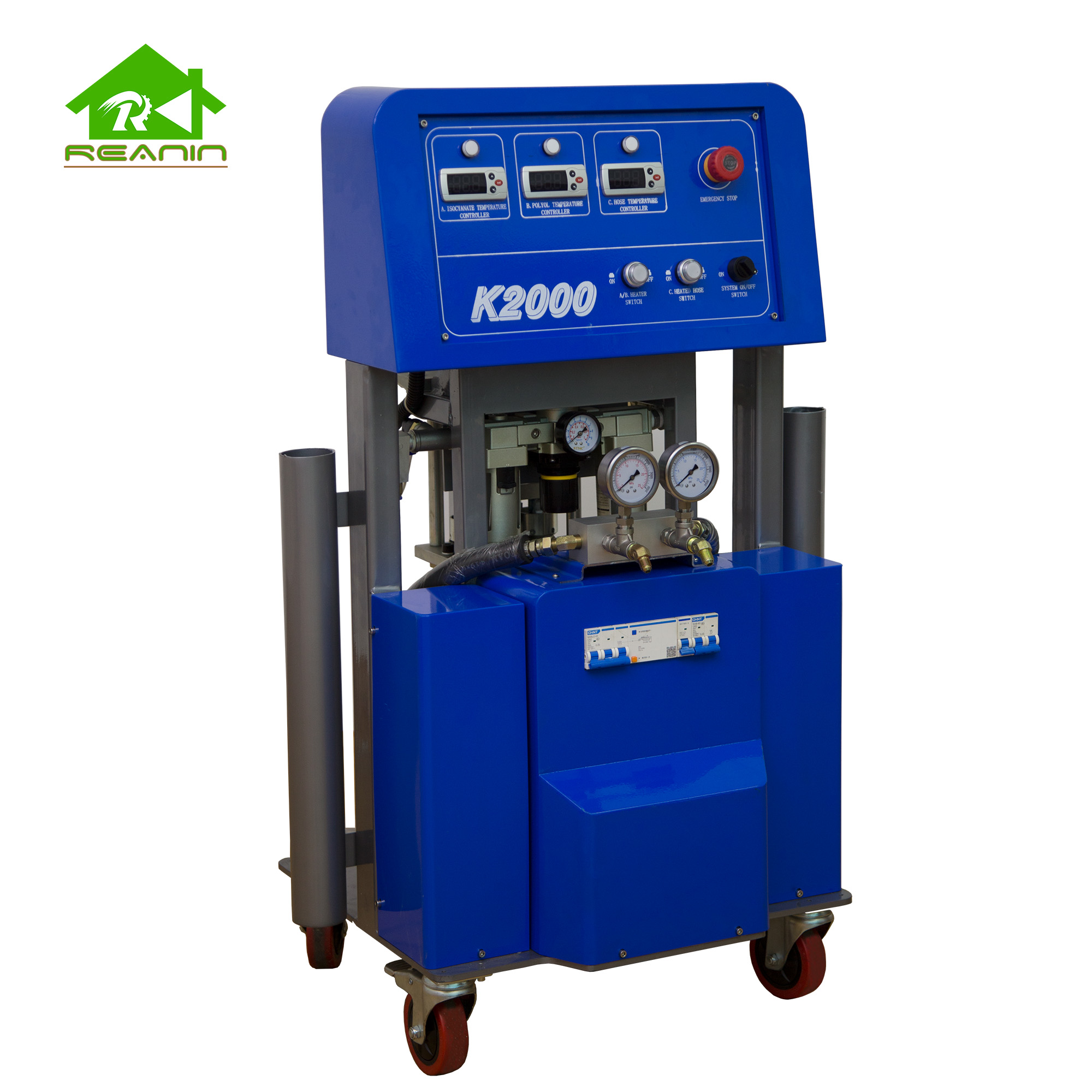
Open-cell foam expands up to 100 times its liquid volume almost instantly upon hitting the substrate. Closed-cell foam only expands 30 to 40 times its liquid volume. This massive difference in expansion rate dictates highly specific machine output settings. A unit optimized solely as a closed cell foam spray machine might struggle with open-cell demands if its heaters are undersized. Open-cell B-side systems are highly water-blown and inherently more viscous than synthetic-blown closed-cell resins. They require different primary heater wattage and specific hose configurations to process correctly. The machine must heat the water-blown resin rapidly to initiate the blowing agent without boiling the chemical in the lines. If the machine cannot handle the viscosity, the pumps will cavitate, introducing air into the system and destroying the foam texture.
Open-cell foam places intense specific heating demands on the proportioning equipment. It often requires much higher pre-heat temperatures to achieve the correct reaction profile compared to closed-cell formulations. Closed-cell chemicals generally react well at lower temperature thresholds. The proportioner must sustain this high heat load continuously during long, high-volume spray passes. If the primary heaters cannot keep up with the fluid flow rate, the chemical temperature drops mid-pass. When the temperature drops, the foam texture suffers immediately. Operators will notice a denser, less yielding structure that fails to fill the wall cavity completely. This requires the machine to have massive heating blocks and efficient thermal transfer designs. You cannot push 20 pounds per minute of open-cell material through a machine designed for low-output touch-ups and expect the cell structure to remain consistent.
A pneumatic polyurethane foaming machine suits entry-level contractors or intermittent use scenarios. It relies entirely on external air compressors to drive the chemical pumps via an air motor. Air motor stalling or icing can cause severe pressure fluctuations that instantly degrade the foam texture. When a pneumatic pump changes direction, there is often a momentary drop in pressure known as a "wink." This wink causes a split-second loss of atomization, leaving a dense streak in the foam pass. Hydraulic systems excel in sustained, high-pressure commercial use. They utilize hydraulic fluid to drive the pumps, providing rigid, continuous pressure without the lag associated with air-driven units. Electric systems offer lower overall power draws and highly precise stroke control using servo motors. Both hydraulic and electric options maintain the consistent dynamic pressure required for uniform open-cell texture over long durations.
High-wattage primary heaters and hundreds of feet of heated hoses demand significant electrical power. These massive electrical demands dictate the necessary generator sizing for any mobile spray rig. Voltage drops from an undersized generator directly lead to heater failure and subsequent texture collapse. If the generator bogs down under the load of an air compressor and the proportioner simultaneously, the chemical temperature plummets. The resulting foam will look glassy, feel crunchy, or fail to expand entirely. You must ensure your power supply exceeds the maximum amperage draw of the proportioner by at least twenty percent. Consistent voltage ensures the heating elements maintain the exact delta-T required for perfect impingement mixing. Never run a high-output proportioner on a generator that struggles to maintain 230 volts under load.
Contractors often need a portable PU foam spray machine for residential touch-ups, tight attic retrofits, or high-rise applications. Pulling hundreds of feet of heavy heated hose from a street-level rig severely compromises temperature control in extreme weather. Portable units reduce hose-heat loss by keeping the proportioning machine close to the actual spray area. They allow for shorter hose runs, which means less voltage drop across the copper heating elements. However, portable units present distinct trade-offs. They typically feature lower maximum fluid output and smaller primary heaters. Operators must balance maneuverability against the need for high-volume production and sustained heat loads. If you push a portable unit past its rated output, the heaters will fail to maintain the set point, and the open-cell foam will cure with a dense, heavy texture.
The physical size of the mixing chamber inside the spray gun heavily influences the final texture. The design of the spray tip, whether a round pattern or a flat fan pattern, also matters significantly. A mismatched chamber size prevents proper atomization, leading to heavy, unexpanded foam. Air-purge guns use a blast of compressed air to clean the mixing chamber after every single trigger pull. Mechanical-purge guns use a physical valving rod to clear the chemicals from the chamber. Maintaining a perfectly clean mixing environment prevents texture-ruining blockages. If the chamber gets partially clogged, the chemical streams will not collide dead-center. This results in an off-ratio, poorly textured spray pattern that often leans heavily toward the A-side or B-side depending on which port is restricted.
Modern proportioning software tracks chemical usage, spray temperatures, and pressure differentials in real-time. Real-time data logging allows contractors to prove quality control to builders and inspectors. It helps optimize material yield by catching mechanical issues early before they waste expensive chemicals. Smart proportioners alert operators to ratio imbalances before they ruin the substrate. They feature automated shut-offs that stop the pumps if the pressure difference between the A and B sides exceeds a set limit. This technology removes the guesswork from achieving the perfect open-cell texture and protects the contractor from liability. If the A-side pressure spikes to 1500 PSI while the B-side drops to 900 PSI, the machine shuts down instantly, preventing you from spraying a massive section of off-ratio foam.
Spongy or shrinking foam almost always points to a B-side rich mixture. This ratio imbalance prevents the cellular structure from locking into place during the curing phase. Insufficient primary heat or heavily clogged A-side filters also cause the foam to collapse on the wall. Look for machines equipped with automated pressure differential shut-offs. These fail-safes stop the pump before off-ratio spraying ruins the texture and requires a tear-out. Regular filter maintenance prevents these flow restrictions entirely. Operators must check the Y-strainers daily to ensure no crystallized Isocyanate restricts the A-side flow. If the A-side is starving for fluid, the B-side pump will overpower the mixing chamber, resulting in a soft foam that shrinks away from the framing members within 24 hours.
Crunchy or brittle foam indicates an A-side rich mixture, meaning too much Isocyanate is reaching the gun. Excessive primary heater temperatures or hose heat spikes also scorch the foam during application. Scorched open-cell foam loses its flexibility, structural integrity, and acoustic dampening properties. Digital temperature controllers are necessary for accurate, real-time thermal monitoring. RTD (Resistance Temperature Detector) sensors placed directly in the fluid stream of the hose provide accurate feedback. They prevent the chemicals from boiling inside the lines and destroying the delicate open-cell structure. If your hose heat is set to 140°F but the RTD sensor is malfunctioning, the actual fluid temperature might exceed 160°F, causing the blowing agent to vaporize prematurely and leaving a brittle, glassy surface.
Texture Failure | Probable Machine Cause | Immediate Mitigation Strategy |
|---|---|---|
Shrinking / Collapsing | B-side rich ratio, low heat, clogged A-side filter | Check pressure differentials, increase primary heat, clean A-side Y-strainer. |
Crunchy / Brittle | A-side rich ratio, excessive heat, hose heat spikes | Lower primary heaters, verify RTD sensor function, check B-side flow. |
Splattering / Uneven | Low dynamic pressure, partially clogged mixing chamber | Increase fluid pressure, clean or replace gun mixing chamber. |
Glassy Surface | Severe temperature drop, generator voltage lag | Stop spraying, allow heaters to recover, check generator output. |
Dense / Heavy Foam | Undersized mixing chamber, low Delta-T lift | Install larger mixing chamber, slow down spray passes to allow heat recovery. |
A construction polyurethane injection machine requires rigorous, uncompromising daily maintenance. Operators must focus heavily on cleaning Y-strainers, lubricating pump packings, and inspecting proportioner seals. Neglected maintenance leads directly to pressure drops and subsequent texture degradation. Worn fluid seals allow chemicals to bypass the pumps, destroying the critical 1:1 volumetric ratio. Routine inspection of these high-wear components ensures consistent atomization and prevents catastrophic pump failure. Maintaining the throat seal liquid (TSL) prevents Isocyanate from crystallizing on the pump shaft and tearing the seals. If the TSL cup runs dry, the crystallized iso acts like sandpaper against the packing nuts, leading to immediate pressure loss on the A-side.
Precise texture control directly impacts material yield and overall job profitability. Off-ratio or poorly expanded open-cell foam consumes significantly more chemical per board foot. This overconsumption drastically reduces margins on large residential or commercial projects. Achieving the maximum expansion rate requires perfect machine calibration and steady environmental control. Every degree of temperature and pound of pressure matters when spraying open-cell formulations. If the machine cannot hold pressure, the foam goes on too dense, eating into the chemical supply rapidly. A machine that consistently sprays 5% off-ratio will cost a contractor thousands of dollars in wasted material over a single month of heavy operation.
Even the most advanced, data-logging proportioner cannot compensate for poor operator technique. Spraying the foam too thick in a single pass or using an improper gun distance ruins the final texture. Upgrading from a basic pneumatic system to a complex hydraulic or electric proportioner requires dedicated training. Operators must learn to read digital interfaces, interpret pressure faults, and adjust delta-T on the fly. Proper training ensures the equipment performs at its peak capability. A skilled operator understands how to listen to the spray gun and watch the foam rise to diagnose machine issues instantly.
To ensure consistent texture control, operators should follow a strict daily startup sequence:
Verify drum temperatures and activate drum band heaters if ambient temperatures are below 60°F.
Check and clean the A-side and B-side Y-strainers to ensure unrestricted fluid flow to the proportioning pumps.
Pressurize the system and check for static pressure imbalances before turning on the primary heaters.
Activate the primary heaters and heated hose, allowing the system to reach the target set point.
Perform a test spray on a piece of cardboard to visually inspect the impingement mixing and expansion rate.
Monitor the dynamic pressure gauges during the test spray to ensure the pressure does not drop by more than 200 PSI.
Consistent open-cell foam texture relies entirely on the machine’s ability to synchronize temperature, pressure, and ratio without fluctuation. For high-volume residential and commercial contractors, prioritize hydraulic or advanced electric proportioners with high-wattage heaters and data-logging capabilities. For specialized, hard-to-reach applications, evaluate a high-end portable unit that does not sacrifice delta-T capabilities. Taking control of your equipment ensures maximum yield and eliminates costly tear-outs.
Review technical spec sheets for maximum hose length and heater wattage capabilities before purchasing new equipment.
Request a live demonstration of the machine's pressure differential fail-safes under a heavy spray load.
Consult with chemical manufacturers to ensure your chosen equipment matches their specific formulation requirements.
Establish a strict daily maintenance schedule for Y-strainers, pump seals, and the spray gun mixing chamber to prevent ratio imbalances.
A: Open-cell foam typically requires a standard operating pressure range of 1000 to 1500 PSI. Dynamic pressure must remain stable during the trigger pull to ensure proper impingement mixing. Any significant pressure drop will cause the chemicals to splatter, resulting in an uneven, poor-quality texture.
A: Shrinking is usually caused by a B-side rich mixture or exceptionally low chemical temperatures. This indicates a need to check your proportioner pump performance for lead-lag issues. You should also verify that your primary heater settings are high enough to properly activate the blowing agents.
A: Yes, most modern proportioners can spray both types of foam. However, switching between them requires adjustments to temperature settings and dynamic pressure. You will also often need to change the spray gun's mixing chamber size to accommodate the different viscosity and expansion rates.
A: Pneumatic machines rely on compressed air, which can fluctuate and cause texture inconsistencies during long trigger pulls. Hydraulic machines offer rigid, continuous pressure driven by hydraulic fluid. This constant force ensures a more uniform atomization and a more consistent open-cell texture over large application areas.
A: The heated hose maintains the chemical viscosity achieved by the primary heaters. It ensures the A and B components mix perfectly at the spray gun rather than cooling and thickening in transit. If the hose loses heat, the chemicals will not atomize properly, ruining the texture.
A: Crunchy or brittle foam usually results from an A-side rich ratio or excessively high heater temperatures. Check for flow restrictions on the B-side and lower your primary heat settings. Always inspect the machine's pressure gauges for imbalances before continuing to spray.


