
Views: 0 Author: Site Editor Publish Time: 2026-07-13 Origin: Site


In a pneumatic proportioner setup, the air compressor serves as the engine of your yield. It powers the transfer pumps, drives the proportioner motor, and purges your spray gun. Inconsistent air delivery directly causes pressure imbalances. These imbalances lead to off-ratio foam, ruined batches, and stalled projects. Fluctuating air flow strips away your control over the chemical reaction. When pressure drops, material mixing suffers instantly. Selecting the right compressor requires looking past marketing claims like "peak horsepower." You must focus strictly on continuous CFM delivery, duty cycles, and moisture control. Equipment longevity depends entirely on steady, dry air. We will provide a technical evaluation framework below. You will learn how to match your pneumatic spray machine with an optimal air system. This ensures consistent pressure, protects chemical integrity, and keeps your rig running smoothly. We guide you through sizing metrics, moisture mitigation, and power integration.
Pneumatic PU foam proportioners typically demand continuous delivery of 15–25+ CFM at 100 PSI; undersizing guarantees equipment failure.
Rotary screw compressors out-perform reciprocating (piston) models in continuous-duty applications like spray foam insulation.
Dry air is non-negotiable: Moisture in the air supply reacts with Isocyanate (A-side), causing crystallization that destroys pump seals.
Fluctuating air pressure severely damages your profit margins. An inadequate air source for foam sprayer setup forces you into constant troubleshooting. Pressure drops below your proportioner’s required threshold rapidly. This causes uneven mixing of A and B chemicals. The resulting foam turns out spongy, brittle, or chemically unsafe. You then face expensive tear-outs. Material waste eats directly into your project budget.
Beyond chemical failures, inadequate airflow destroys your hardware. Starved of air, the pneumatic motor begins to stall. It often short-strokes under heavy load. This abnormal cycling accelerates wear on seals and fluid sections. Pump cavitation occurs frequently during low-pressure events. Cavitation introduces air bubbles into the chemical lines. You end up replacing expensive internal components prematurely. Lost days waiting for replacement parts hurt your bottom line.
Many contractors fall into the "peak vs. continuous" rating trap. Hardware store compressors boast high "peak CFM" numbers. These ratings only reflect short bursts of power. Air demand in spray foam is entirely sustained. It is never intermittent. Relying on peak ratings guarantees project downtime. You need a system built for relentless, continuous output. We see operators burn out consumer-grade units within weeks. Investing in industrial-grade air generation prevents these costly failures. You must view the compressor as the heart of your fluid dynamics. When it falters, every downstream component suffers. The labor cost of cleaning crystalized A-side chemical far exceeds the price difference between a cheap piston compressor and a professional continuous-duty model. We advise contractors to treat their air supply with the same respect as their chemical supply.
Mapping compressor specifications to your proportioner demands requires precision. You cannot guess these metrics. Every component drawing air adds to the total load. An undersized air compressor for PU foam spray machine system cripples performance. We must evaluate output capacity and operational endurance.
A simple rule of thumb guides your sizing strategy. The compressor must exceed the maximum CFM rating of the proportioner. You must also add the requirements of transfer pumps. Include agitators and purge air tools in your calculations. We recommend adding a 20% safety buffer to this total. This buffer accounts for natural friction in your air hoses. It also covers minor leaks that develop over time. Air tools lose efficiency as they age. A buffer ensures you never starve the proportioner during critical spray phases.
Consistent pressure is your ultimate goal. Your standard target is reliable delivery between 90 and 120 PSI. If pressure drops during a long spray pass, mixing ratios fail. Calculate your cumulative CFM carefully. We outline a typical load calculation below:
Determine base proportioner requirements (e.g., 20 CFM).
Add transfer pump requirements (usually 3-5 CFM each).
Factor in drum agitators (typically 2-3 CFM).
Include breathing apparatus demands if connected.
Apply the 20% safety buffer to account for line loss.
You have two primary technologies to consider. Reciprocating models offer lower upfront costs. However, they carry severe limitations. Piston units max out at a 50–60% duty cycle. They need extended time to cool down. They remain highly prone to overheating during continuous spraying. High operating temperatures also increase moisture condensation inside the tank.
Rotary screw units deliver a massive upgrade. They handle a 100% duty cycle effortlessly. These compressors generate less heat. They also run much quieter. Rotary screw models remain the absolute standard for commercial rig build-outs. They offer the endurance required for long insulation jobs. We highly recommend them for any professional outfit. Rotary screw models use two interlocking helical rotors. These rotors compress air continuously without the aggressive pulsing associated with piston strokes. This smooth delivery translates to a stable spray pattern at the gun tip. Your spray foam yield improves noticeably.
Evaluation Feature | Reciprocating (Piston) | Rotary Screw |
|---|---|---|
Duty Cycle Capacity | 50% - 60% Maximum | 100% Continuous |
Overheating Risk | High during sustained use | Very Low |
Noise Levels | Very loud, heavy vibration | Quieter, smoother operation |
Rig Suitability | Small touch-ups only | Commercial scale spraying |
Maintenance Needs | Frequent valve and ring checks | Periodic oil and filter changes |
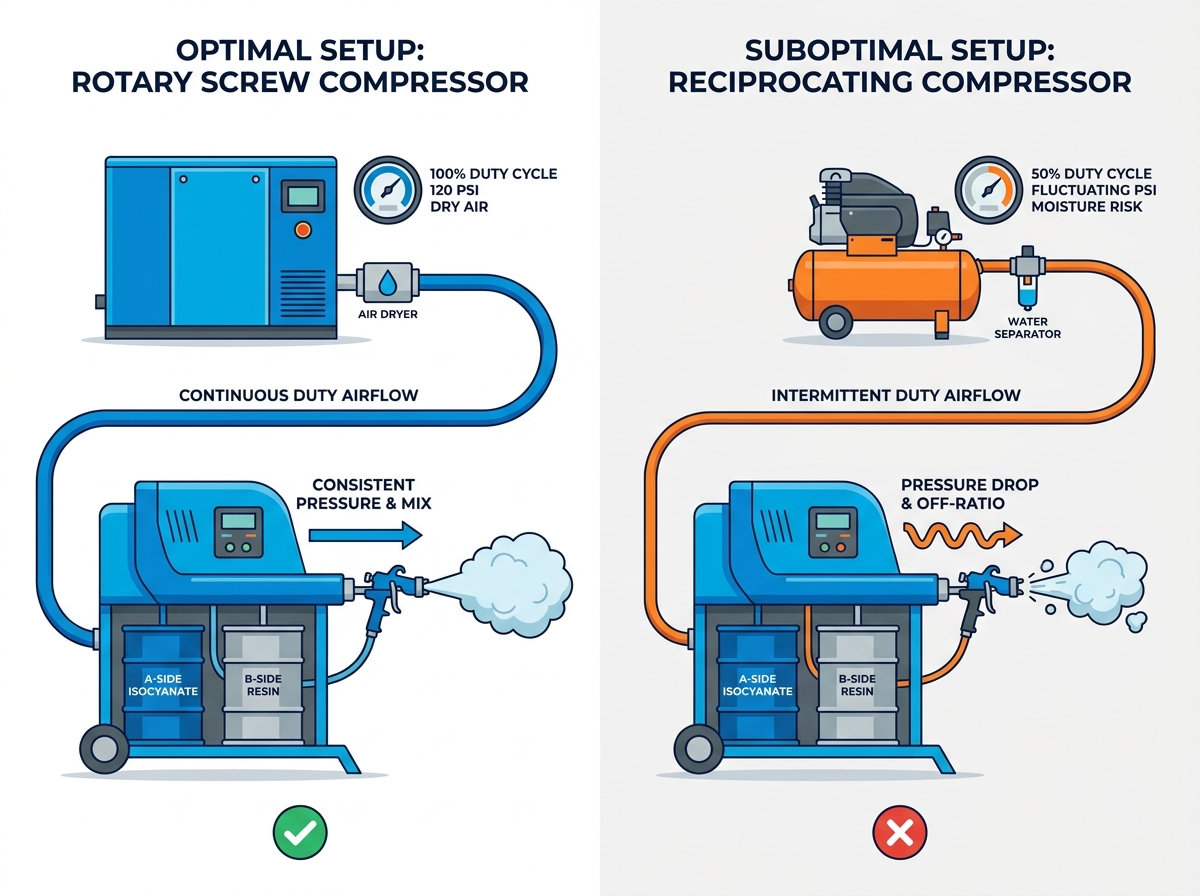
Moisture presents a severe implementation risk. Your compressor pulls in ambient environmental humidity. It compresses this moisture along with the air. As the air cools, humidity condenses into liquid water. This water travels directly through your air lines. Any pneumatic spray machine compressor setup requires rigorous moisture management.
The A-side chemical (Isocyanate) is extremely moisture-sensitive. Water introduced via drum pumps reacts instantly. It also enters through purge air tools. The reaction causes rapid crystallization inside your system. These hard crystals tear through pump seals. They clog heaters and destroy proportioner internals. This leads to catastrophic equipment failure. Cured isocyanate inside a fluid section often requires complete replacement.
You must build specific drying infrastructure into your rig. A basic inline filter is completely inadequate. Consider these required components for moisture defense:
High-temperature refrigerated air dryers matched to your CFM.
Desiccant drying systems for extreme humidity zones.
Inline bulk water separators placed after the receiver tank.
Coalescing particulate filters installed before the proportioner.
Proper placement of these filters prevents contamination. Install dryers as close to the air source as possible. Drain your receiver tanks daily to remove bulk liquid. Clean, dry air extends equipment life significantly. We consider moisture control the most critical safeguard in any pneumatic spray rig. Do not bypass refrigerated dryers to save money. The resulting damage to proportioner heating blocks is devastating. We recommend using a multi-stage filtration approach. First, drop out the heavy liquid water. Next, chill the air to condense remaining vapor. Finally, filter out fine oil mist and particulates. This sequence ensures pristine air reaches your sensitive equipment.
You must evaluate the physical and operational setup of your rig. Selecting the ideal air compressor for polyurethane machine layout involves power constraints. You also face strict space limitations inside a mobile trailer. Trailer rigs demand highly efficient equipment placement.
Electric configurations require careful electrical load calculations. You must size your generator appropriately. It must handle the high start-up amperage of the proportioner heaters. It also must support the electric compressor motor. Undersized generators will trip breakers constantly. Inrush currents during motor startup can spike significantly. We recommend consulting an electrician to balance your power distribution panel.
Gas or diesel engine-driven compressors offer a distinct alternative. They free up significant electrical load on your generator. This allows you to run a smaller generator for the proportioner. However, they require direct external venting. You must manage a secondary fuel source daily. Careful placement ensures exhaust safety inside enclosed trailers. Heat management becomes critical when running internal combustion engines.
Trailer payload limits dictate your equipment choices. Overweight trailers pose serious road safety hazards. You must balance capacity against footprint. Tongue weight distribution impacts towing stability. Tank sizing requires careful thought and planning.
A 30-gallon tank saves valuable floor space. However, it provides a smaller buffer for air demand. A 60-gallon or 80-gallon receiver tank buffers fluctuating demand much better. It takes up a larger vertical or horizontal footprint. Choose a vertical tank layout to conserve square footage in tight rigs. Ensure adequate airflow around the compressor block for cooling purposes. Many builders construct custom metal cages over their compressors. This protects the unit while allowing heat to escape. If you block the cooling fan intake, even a premium compressor will overheat. Keep air intakes clear of foam overspray. Airborne chemicals easily clog intake filters, reducing CFM output severely.
Building a reliable rig requires a step-by-step buyer framework. Understanding your exact PU foam compressor requirements prevents costly sourcing mistakes. Follow a logical path to shortlist your best options. Guessing capacities leads directly to job site failures.
First, audit your existing equipment thoroughly. Aggregate the total CFM draw of your entire system. Start with the main proportioner demand at peak pressure. Add the draw of two transfer pumps operating simultaneously. Include your mixing agitator air consumption. Factor in supplied safety masks if they run on the same air system. This total represents your absolute operational baseline. We see many operators forget to include transfer pump air draw.
Next, verify the compressor duty cycle. You must filter out any compressor lacking continuous run capabilities. If a unit cannot run endlessly at your aggregated CFM demand, discard it. Do not compromise on endurance ratings. Spraying a commercial roof requires uninterrupted air supply for hours.
Your actionable next step is simple. Pull the Technical Data Sheet (TDS) for your specific PU foam proportioner. Read the manufacturer air requirements thoroughly. Do this before finalizing any compressor purchase. Aligning your power source with the TDS specifications guarantees smooth operation. Consult with your equipment distributor to confirm your math. They often possess specific integration guides for popular machine pairings. We also suggest planning for future expansion. If you plan to upgrade to a higher-output proportioner later, size your compressor for that future machine today. Buying an air system twice destroys your capital budget.
Sizing your compressed air system is never an area for cost-cutting. Consistent pressure guarantees consistent foam yield and chemical stability. Subpar air delivery ruins materials and shuts down jobsites. Rigorous planning up front saves you from expensive repairs later. Your reputation relies on delivering high-quality insulation. You cannot achieve this with erratic air pressure.
We highly recommend prioritizing rotary screw configurations. Pair them with integrated refrigerated air drying for commercial-scale operations. This setup protects your proportioner seals and ensures top-tier spray quality. A well-designed air system operates quietly in the background. It allows you to focus entirely on applying foam.
Take these immediate next steps to optimize your setup:
Map your cumulative rig airflow demand accurately using manufacturer data.
Install robust moisture removal systems near the proportioner intake.
Monitor pressure gauges dynamically during initial spray passes.
Drain compressor receiver tanks at the end of every shift without fail.
Clean air intake filters weekly to maintain maximum CFM efficiency.
A: The exact requirement varies by machine size. However, commercial entry-level units typically require a minimum of 15 to 20 CFM delivered continuously at 100 PSI. Always aggregate the demand of your proportioner, transfer pumps, and accessories to find your true minimum baseline.
A: No. Pancake and small piston units carry severe duty cycle limitations. They easily overheat under sustained loads. These small compressors are only viable for low-pressure, small-scale touch-up kits. Full-scale commercial rigs require continuous-duty rotary screw compressors.
A: You must install dedicated drying infrastructure. Use inline water separators directly after the compressor. Follow them with high-temperature refrigerated air dryers. Install particulate filters just before the air reaches the proportioner. You should also drain your air receiver tanks daily.
A: You do not necessarily need separate compressors. A single large compressor can run the proportioner, pumps, and respirator simultaneously. However, you must calculate the CFM cumulatively. Keep in mind that breathing air requires specialized Grade-D filtration systems installed inline.


