
Views: 0 Author: Site Editor Publish Time: 2026-09-18 Origin: Site


Contractors often bleed capital simply by deploying mismatched equipment. Output mismatches create massive production bottlenecks across job sites. Force a small rig to spray a sprawling commercial roof, and your internal heaters will inevitably fail to keep up. The fluid pressure drops dramatically. Consequently, the resulting foam turns out brittle and off-ratio. On the flip side, purchasing unnecessarily massive machinery drains your operating budget and turns logistics into a nightmare for minor residential tasks.
In this comprehensive engineering guide, you will learn how to evaluate your exact operational demands. We will break down how to select the ideal polyurethane foam spray machine to maximize daily yield, ensure strict chemical stability, and ultimately protect your bottom line.
Output dictates mechanical architecture: Low-volume residential retrofits require entirely different heating and pumping mechanisms than high-volume continuous manufacturing lines.
Mobility versus Brute Power: A portable unit excels in agile, tight-space tasks. Hydraulic systems deliver the raw power necessary for heavy-duty, continuous applications pushing material through hundreds of feet of hose.
Application methodology matters: Specialized geotechnical tasks, such as concrete lifting or foundation sealing, demand a dedicated injection proportioner rather than standard spray gear.
Material compatibility is non-negotiable: Processing dense, high-R-value insulation requires a robust system capable of maintaining precise heat and dynamic pressure to guarantee optimal dimensional stability.
Selecting the correct machinery begins with a precise evaluation of your daily output requirements. In the polyurethane industry, equipment capacity is standardly measured in kilograms per minute or pounds per minute. This critical metric dictates how rapidly the proportioner can heat, mix, and deliver the A-side Isocyanate and B-side Polyol chemicals to the impingement chamber of the gun. Choosing a system that misaligns with your project scale inevitably leads to severe operational delays.
Proportioners in this category typically process under 8 kilograms per minute. They are engineered specifically for touch-ups, residential attic insulation, small structural repairs, and bespoke fabrication. These units provide sufficient fluid flow for detailed, intricate work where precision is prioritized over sheer volume. Operating a low-output unit on a massive commercial project will quickly exceed its duty cycle, resulting in overheated motors and inconsistent chemical blending.
This range, generally processing between 8 and 12 kilograms per minute, represents the sweet spot for growing commercial contractors. These crews handle standard building insulation, interior wall cavity spraying, and medium-scale roofing retrofits. Medium-output systems offer an excellent balance of application speed and operator control. Experienced technicians can cover significant square footage without outpacing the equipment's primary heating capacity.
High-output infrastructures are mandatory for industrial manufacturing, continuous sandwich panel production, and expansive commercial roofing. When technicians are spraying large flat roofs or pouring foam into massive structural molds, the machinery must sustain immense flow rates over extended periods. These systems prevent pressure degradation or temperature fluctuations even when running continuously.
For independent contractors, residential insulation teams, and small custom workshops, on-site mobility often outweighs raw pumping power. Navigating tight spaces presents unique logistical challenges. Sweltering residential attics, cramped crawlspaces, and narrow rim joists require specialized gear. A portable PU foam spray machine is specifically designed to overcome these hurdles.
The core advantage of portable equipment lies in its maneuverability and lower initial capital investment. Specifically, compact units like the Reanin K2000 series typically operate on standard 220V single-phase electrical power. This eliminates the need to tow heavy, expensive three-phase generators to minor job sites. Featuring around 6kW of total heating power and a maximum output of 8 kilograms per minute, they are highly effective for gap filling and minor renovations where deploying a full-sized commercial rig would be economically unviable.
However, operators must approach portable machinery with a clear understanding of its mechanical limitations. These units have strict duty cycles. They are not engineered for continuous, all-day trigger pulling. Pushing a portable proportioner beyond its specified limits causes the internal heating blocks to fall behind. Consequently, the chemical viscosity increases, leading to pressure imbalances, poor foam yield, and potential substrate adhesion failure.
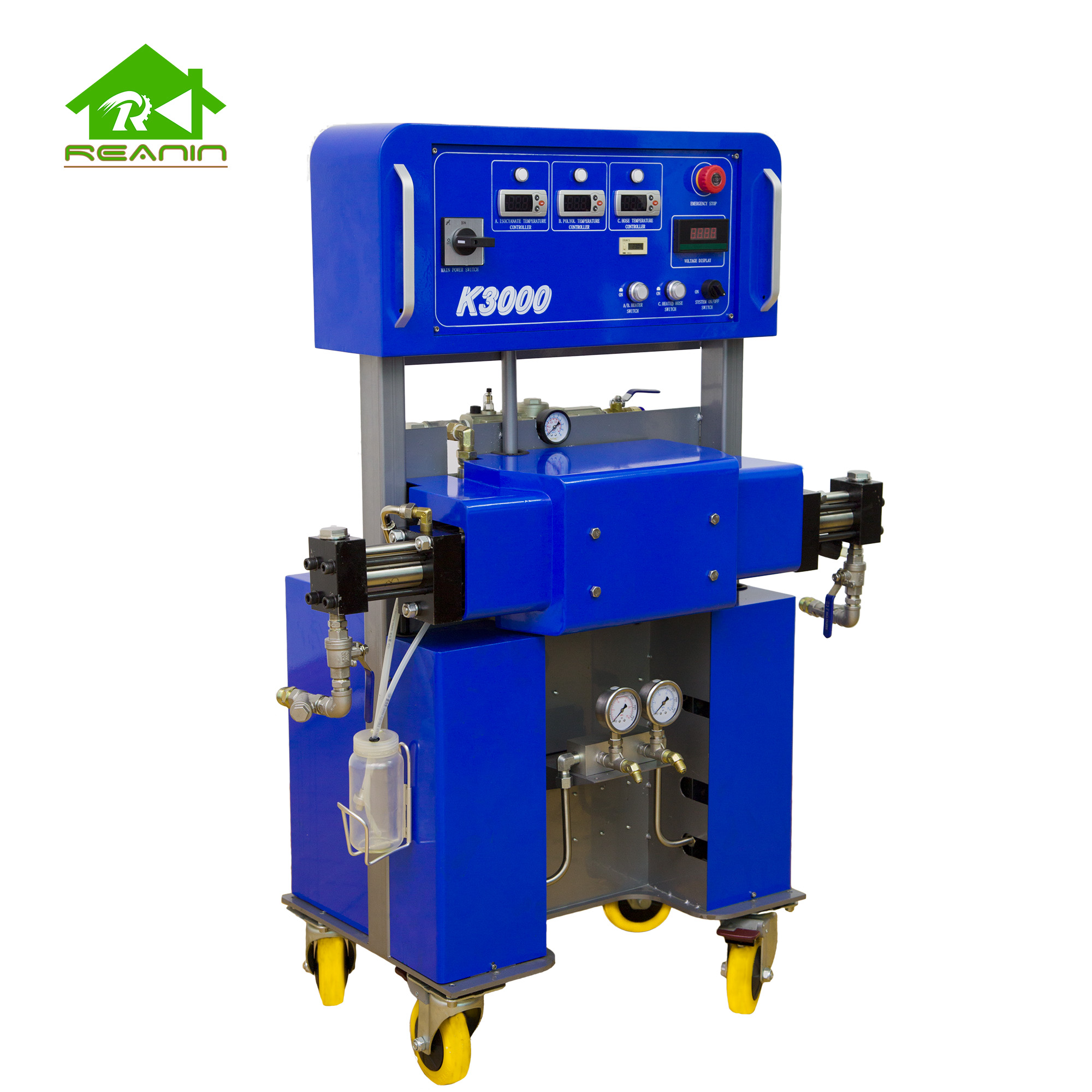
As contracting businesses expand and secure larger commercial insulation contracts, the demand for consistent, daily output scales up accordingly. For mid-sized commercial crews, the pneumatic polyurethane foaming machine is widely recognized as the most cost-effective and reliable workhorse available.
Pneumatic systems utilize an external air compressor to drive the fluid pumps. When the technician triggers the gun, compressed air forces the proportioning pumps to push the highly reactive chemicals through heated hoses. This air-driven mechanism provides an outstanding balance between operational cost and rugged on-the-job performance.
Take the Reanin K3000 as a prime engineering example. It delivers up to 12 kilograms per minute with a robust 9kW heating system. Furthermore, the primary advantage of a pneumatic system is its mechanical simplicity. Compared to highly complex hydraulic architectures, pneumatic proportioners feature fewer moving parts. This translates directly to easier field troubleshooting and lower routine maintenance costs. Field mechanics can often rebuild pneumatic air motors on-site using standard hand tools, drastically minimizing costly downtime. These systems easily support up to 90 meters of heated hose, offering a highly favorable return on investment for scaling businesses.
When production demands escalate to high-rise commercial roofing or structural insulated panel production, pneumatic systems frequently reach their operational limits. In these extreme-demand environments, hydraulic polyurethane systems remain the undisputed industry standard.
Hydraulic proportioners utilize pressurized hydraulic fluid to drive the chemical pumps. This advanced mechanism provides maximum dynamic pressure consistency. Consistent pressure is absolutely critical when spraying massive volumes of material over long durations. One of the most significant technical advantages here is the minimization of pressure drop during the pump stroke changeover. A smoother directional changeover ensures a perfectly consistent spray pattern, maintaining uniform foam density across expansive surface areas.
In addition, high-output hydraulic machinery possesses the mechanical brute force required to push highly viscous materials through exceptionally long hose runs. These runs often exceed 300 feet. This is a strict requirement for commercial high-rise projects where the rig must remain parked at ground level. In factory settings, these high-output units integrate seamlessly into continuous sandwich panel lines, delivering an uninterrupted flow of material to automated pouring heads.
While spray applications dominate the thermal insulation sector, civil engineering and foundation repair demand an entirely different methodology. Injecting polyurethane into subterranean voids, loose soils, or beneath sunken concrete slabs requires specialized geotechnical equipment. For these tasks, professionals rely on a dedicated construction polyurethane injection machine.
The fundamental distinction between spraying and injecting lies in fluid dynamics and pressure management. Spraying atomizes the chemicals into a fine mist that expands immediately upon contact with a substrate. In contrast, injection involves pumping dense liquid chemicals through mechanical packers directly into confined spaces. The foam expands forcefully to fill voids, stabilize shifting soil, or lift heavy concrete slabs in a highly technical process known as slab jacking.
For these intense applications, the equipment must handle high-density geotechnical foams. These materials possess vastly different viscosity and expansion profiles compared to standard wall insulation. A dedicated injection proportioner features ultra-precise ratio controls and robust pressure monitoring gauges. Because technicians are injecting material into blind voids, they rely heavily on the machine's pressure feedback to determine when a cavity is filled or a slab has reached the correct elevation. Using standard spray gear for heavy-duty concrete lifting often results in blown hoses or severe ratio imbalances.
The specific type of chemical being processed heavily dictates your equipment selection. Polyurethane foam generally falls into two distinct categories: open-cell and closed-cell. Open-cell foam is lighter, highly expansive, and typically uses water as its primary blowing agent. Closed-cell foam is dense, rigid, waterproof, and provides a significantly higher thermal resistance per inch. This makes it the premier choice for exterior commercial applications and vapor barriers.
Spraying closed-cell formulations places significantly higher demands on the proportioner. The chemicals are inherently more viscous and require stricter temperature and pressure parameters to achieve proper atomization. If the material is not heated adequately, the Isocyanate and Polyol will fail to mix thoroughly inside the gun. This leads to an improper chemical index, resulting in defective foam that shrinks, pulls away from the framing, or fails to achieve its intended structural rigidity.
Therefore, procuring an effective closed cell foam spray machine requires careful evaluation of the internal heating infrastructure. The system must feature high-wattage primary heaters capable of rapidly raising the chemical temperatures to processing levels, typically between 120 and 140 degrees Fahrenheit. It must maintain that temperature differential even at maximum flow rates. Investing in a unit with underpowered heaters will inevitably result in wasted chemical drums and compromised insulation performance.
Before finalizing the purchase of any industrial foaming machinery, decision-makers must evaluate several core technical specifications. Relying solely on maximum output claims can lead to operational inefficiencies. A thorough technical assessment ensures the equipment aligns with your specific chemical formulations and job site environments.
Specification Category | Importance for Polyurethane Application | Impact on Production |
|---|---|---|
Heating Capacity | Determines how quickly the machine can heat viscous chemicals to the required processing temperature. | Undersized heaters force operators to slow down to allow the machine to catch up, drastically reducing daily yield. |
Proportioning Ratio | Most standard foams require a strict one-to-one volume ratio. Specialized foams may require variable metering. | Inaccurate ratios produce crunchy or spongy foam that will not cure, requiring costly manual removal. |
Power Supply | Machines require specific electrical setups, such as 220V Single-Phase versus 380V Three-Phase. | Buying a three-phase machine for residential jobs without a properly sized mobile generator renders the equipment useless. |
Hose Length Capacity | The maximum length of heated hose the fluid pumps can push material through before experiencing severe friction loss. | Crucial for commercial roofing or high-rise jobs where the proportioner must remain parked far from the spray area. |
Capital expenditure represents only a fraction of the total cost of ownership. Operational expenditure ultimately determines your long-term return on investment. This includes routine maintenance, unexpected downtime, spare parts, and material waste.
Recent engineering analysis highlights a rapid, regulation-driven shift toward sustainable practices and smart equipment across the insulation sector. As global environmental agencies phase out legacy blowing agents due to their high global warming potential, the market is aggressively adopting eco-friendly hydrofluoroolefins. These modern formulations possess different boiling points and viscosity profiles compared to older chemicals. Consequently, progressive contractors are upgrading to proportioners equipped with highly sensitive, digital temperature controls. This precision prevents new blowing agents from frothing prematurely in the fluid lines.
Furthermore, modern job sites increasingly demand IoT-enabled monitoring systems. These smart modules track chemical usage, spray temperatures, and pressure differentials in real-time. This data-driven approach drastically reduces material waste and ensures strict building code compliance.
Beyond advanced technology, basic maintenance remains non-negotiable. Polyurethane chemicals are highly reactive. Isocyanate crystallizes instantly upon exposure to moisture. Decision-makers must prioritize machinery that offers easy access to replacement parts, easily serviceable fluid pumps, and standardized O-rings. Sourcing equipment from a reputable manufacturer with a robust warranty and accessible technical support is critical. When a rig goes down on a commercial site, direct access to expert troubleshooting can salvage a tight project timeline.
Choosing the right equipment depends entirely on your daily production needs, typical job site environments, and specific material requirements. Do not under-size your machinery simply to save on initial capital costs. Undersized equipment inevitably causes expensive downtime, wastes highly valuable chemical materials, and frustrates your application crew.
Match your machine's mechanical architecture to your specific application. Whether that is agile residential spraying, continuous commercial roofing, or heavy-duty concrete lifting, proper alignment is key. Evaluate technical specifications such as heating capacity, pump drive mechanisms, and power requirements carefully before making a final decision. By investing in the correct technology today, you ensure consistent foam quality, protect your profit margins, and position your business for long-term growth.
Stop letting equipment limitations dictate your project capacity. Visit chinareanin.com today to explore a full lineup of professional-grade polyurethane proportioners, compare precise technical specifications, and consult with engineering experts to configure the exact machine your business needs to scale profitably.
The primary difference lies in the drive mechanism powering the fluid pumps. Pneumatic machines utilize an external air compressor to drive an air motor, which in turn drives the chemical pumps. They are highly valued for their mechanical simplicity, lower initial cost, and suitability for medium-output applications. Hydraulic machines use a closed-loop hydraulic fluid system. This mechanism provides unmatched pressure consistency, smoother pump changeovers, and the raw power necessary for high-output, continuous commercial applications.
Generally, no. While a portable unit is excellent for agile, low-output tasks, it lacks the technical specifications required for commercial roofing. Roofing applications demand high-density foams applied over massive surface areas, requiring the machine to process high volumes of material per minute. Furthermore, commercial roofing often requires pumping chemicals up multiple stories through hundreds of feet of hose. Portable machines simply do not possess the heating capacity or fluid pressure to overcome the friction and gravity associated with these high-rise applications.
Closed-cell polyurethane chemicals are inherently thicker than open-cell formulations. Consistent, high heat is required to thin the chemicals to an optimal viscosity, allowing them to atomize properly when they collide at high pressure inside the spray gun's mixing chamber. If the heating system fails to maintain the correct temperature, the chemicals will not mix thoroughly. This leads to a poor chemical reaction, resulting in foam that lacks its specified thermal resistance, fails to adhere to the substrate, and suffers from severe shrinkage.
A construction injection proportioner requires rigorous, scheduled maintenance to prevent chemical crystallization and mechanical failure. Daily maintenance includes cleaning the injection gun's mixing chamber, greasing fittings, and ensuring the pump's lubrication cup is filled with the correct neutralizing fluid. Weekly and monthly tasks involve inspecting and cleaning the strainers on both the chemical lines, checking hydraulic fluid levels, and verifying pressure sensor calibration. Proper storage protocols, including flushing the system with approved solvents, are also mandatory if the machine sits idle.
In fluid dynamics, pushing a viscous liquid through a hose generates friction against the internal walls, resulting in a gradual loss of pressure. The longer the hose, the greater the friction and subsequent pressure drop. For instance, a machine generating 1200 PSI at the primary pumps may only deliver 900 PSI at the spray gun if the hose stretches 200 feet. To counteract this, high-output industrial machines are engineered with larger fluid motors capable of generating massive initial pressures to ensure proper chemical atomization at the end of maximum hose lengths.
Selecting the correct generator requires calculating the total running wattage of all your equipment combined, plus an additional buffer for startup surges. You must account for the proportioner's primary heaters, hose heaters, motor drive, the air compressor, and any auxiliary equipment like fresh air breathing systems or lighting. As a rule of thumb for engineering safety, calculate the total peak wattage and add a 25 to 30 percent safety margin. Running a generator near its absolute maximum capacity causes voltage drops that can severely damage the sensitive electronic circuit boards inside modern proportioners.
The lifespan of a heated hose heavily depends on job site handling and maintenance, but a well-cared-for set can last several years. The most common cause of premature hose failure is physical damage, such as dragging the hose over sharp metal edges, running over it with vehicles, or kinking it tightly around corners. To extend its life, always use a protective scuff jacket, coil the hose in wide loops during storage, and avoid pulling the entire weight of a long hose run directly from the gun connection. Additionally, ensuring your machine's temperature sensors are calibrated prevents the internal heating elements from burning out the hose lining.
An off-ratio event occurs when the machine fails to deliver the exact one-to-one volume of A-side and B-side chemicals to the gun. This is typically caused by a flow restriction on one side of the system. Common culprits include a clogged strainer, a worn pump seal, a restriction in the heated hose, or a blockage inside the spray gun's side ports. Advanced proportioners detect this by monitoring the pressure differential between the two fluid lines and will automatically shut down if the difference exceeds a safe threshold. Resolving it requires systematically checking the fluid path, cleaning filters, and ensuring the spray gun is entirely free of cured material.


