
Views: 0 Author: Site Editor Publish Time: 2026-07-23 Origin: Site


Inconsistent spray polyurethane foam (SPF) application directly erodes profit margins through wasted material, compromised R-values, and costly callbacks. Achieving uniform foam coverage is rarely an issue of operator technique alone. It stems from equipment limitations in maintaining precise chemical ratios, fluid dynamics, and temperature stability at the proportioner level. When you are on a job site, dealing with fluctuating ambient temperatures and demanding substrates, your equipment must perform flawlessly. Evaluating the operational capabilities and technical tolerances of a polyurethane foam spray machine is critical for contractors looking to mitigate application risks, eliminate equipment jamming, and guarantee predictable yields. We see too many operators struggle with off-ratio foam simply because their proportioner cannot handle the dynamic pressure requirements of modern chemical sets. Upgrading and maintaining the right machinery ensures you hit your target board footage every single time.
Temperature and Pressure Dictate Yield: Maintaining strict temperature ranges (typically 140-185°F / 60-85°C) and dynamic pressure is non-negotiable for proper chemical atomization and uniform coverage.
Equipment Selection Impacts Scalability: High pressure PU foam equipment is required for commercial-grade closed-cell applications, offering superior impingement mixing compared to low-pressure or DIY alternatives.
Maintenance Prevents Catastrophic Failure: Strict adherence to daily and long-term shutdown procedures—including proper depressurization and moisture sealing—prevents isocyanate crystallization and costly proportioner rebuilds.
Compliance is Mandatory: Operator safety, strict site isolation protocols, and environmental controls are critical evaluation criteria for any commercial insulation project.
Successful spray foam application relies on achieving consistent R-value per inch, dimensional stability, optimal cell structure, and maximizing board-foot yield per drum set. When a system sprays off-ratio foam, contractors face severe financial impacts. You deal with material shrinkage, poor substrate adhesion, and wasted chemical that eats directly into your project budget. Medium-density closed-cell foam (typically 2.0 pcf) requires different application parameters and backpressure settings compared to low-density open-cell foam. Operators must understand how physical density demands specific fluid dynamics to ensure the foam expands uniformly across the building envelope.
Field metrics dictate that a standard set of closed-cell foam should yield approximately 4,000 to 4,500 board feet under optimal conditions. If your yield drops below 3,800, you are likely facing equipment inefficiencies. The chemical reaction relies entirely on the kinetic energy generated at the gun tip. If your proportioner fails to deliver the required pressure, the A and B sides will not mix properly. This results in a spongy, unstable product that fails building code inspections and requires complete removal.
Foam Type | Density (pcf) | Typical Pressure (PSI) | Primary Application | Yield Expectation (Board Feet) |
|---|---|---|---|---|
Open-Cell | 0.5 | 1,000 - 1,200 | Interior walls, attics, soundproofing | 14,000 - 16,000 |
Closed-Cell | 2.0 | 1,200 - 1,500+ | Exterior walls, roofs, vapor barriers | 4,000 - 4,500 |
Roofing Foam | 2.5 - 3.0 | 1,500 - 2,000 | Commercial flat roofs, exterior tanks | 2,800 - 3,200 |
The core function of a polyurethane foam spray machine is metering polyol (Resin/B-side) and isocyanate (Iso/A-side) at exact 1:1 volumetric ratios. The machine's primary heaters and proportioning pumps work in tandem to deliver these chemicals to the gun for high-velocity impingement mixing. If the pumps fail to maintain equal pressure on both the A and B sides, the resulting chemical imbalance compromises the foam's structural integrity and thermal resistance.
We monitor the pressure gauges constantly during application. A pressure differential of more than 200 PSI between the A and B sides indicates a severe problem. This differential usually stems from a restriction in the fluid lines, a failing transfer pump, or cold chemical temperatures increasing the viscosity of the A-side. The proportioner must overcome these variables to push the chemical through hundreds of feet of heated hose. Modern systems utilize advanced control boards to monitor these pressure spikes and automatically shut down the system before off-ratio foam reaches the substrate.
Commercial and residential building envelopes demand high-pressure systems operating between 1,000 and 2,000+ PSI for proper chemical atomization. Reliable high pressure PU foam equipment utilizes this kinetic energy to ensure the A and B chemicals mix thoroughly at the gun tip. This contrasts sharply with low-pressure systems or portable DIY kits, which often struggle with lower yields, reduced durability, and limited duty cycles unsuitable for large-scale contracting work.
When you are spraying a 10,000 square foot warehouse roof, you need a machine that can run continuously for eight hours without overheating or losing pressure. High-pressure systems feature larger primary heaters and more robust fluid sections. They can push material through 300 feet of hose while maintaining the exact temperature required for the chemical reaction. This capability separates professional contractors from amateurs. You cannot achieve a smooth, monolithic layer of closed-cell foam on a corrugated metal deck using low-pressure equipment.
Contractors must choose the right drive system based on their operational volume and mobile rig setup. A pneumatic polyurethane foaming machine offers a lower entry cost but requires a substantial air compressor to drive the proportioner pumps. Hydraulic systems provide highly consistent pressure and support high duty cycles, making them ideal for high-volume commercial work. Electric proportioners offer energy efficiency and lower maintenance requirements. The decision framework depends heavily on available rig power, daily output requirements, and the crew's maintenance capabilities.
Drive System | Pros | Cons | Best For |
|---|---|---|---|
Pneumatic | Lower initial cost, simple maintenance, reliable in harsh conditions. | Requires massive air compressor, pressure can fluctuate during rapid triggering. | Entry-level contractors, residential insulation, smaller mobile rigs. |
Hydraulic | Extremely consistent pressure, high duty cycle, handles thick materials well. | Higher initial cost, heavier, requires hydraulic fluid maintenance. | High-volume commercial roofing, continuous daily operation. |
Electric | Energy efficient, smooth operation, lower maintenance than hydraulic. | Complex electrical troubleshooting, sensitive to power surges. | Mid-to-large residential, contractors seeking lower operating costs. |
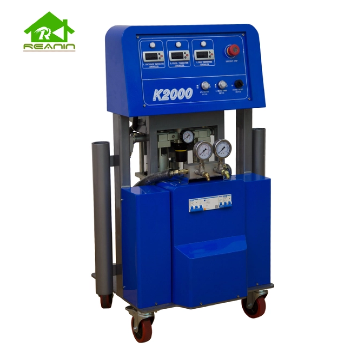
While standard spray applications dominate the insulation market, contractors frequently encounter pour-in-place, concrete lifting, or cavity injection requirements. A dedicated polyurethane injection machine handles these specialized modalities by delivering material at specific flow rates rather than atomizing it into a spray pattern. Equipment capable of switching between spray and injection modes provides contractors with valuable versatility on complex job sites.
Concrete lifting, or slab jacking, requires injecting high-density foam beneath sunken concrete slabs. The machine must push the chemical through small drilled holes against immense backpressure. A standard spray setup will fail here. You need specialized injection guns and a proportioner calibrated to deliver slow, controlled shots of material. This prevents the foam from blowing out the sides of the slab and ensures a controlled lift. Having a machine that can handle both a wall cavity pour and a standard roof spray maximizes your return on investment.
Managing chemical viscosity through precise heating is critical. Cold chemicals result in thick, sluggish flow, poor impingement mixing, and immediate equipment jamming. Operators must utilize recirculation mode, using transfer pumps to circulate chemical back into the drums before spraying to achieve uniform core chemical temperatures. Maintaining the ideal 60-85°C (140-185°F) range requires synchronized operation of primary heaters and heated hoses to ensure a stable Delta-T (temperature change) from the machine to the spray gun.
We follow a strict pre-heating protocol every morning before pulling the trigger. Skipping these steps guarantees a clogged gun and wasted material.
Verify drum temperatures using an infrared thermometer. Ensure drums are stored above 65°F.
Engage the transfer pumps and open the recirculation valves on the proportioner manifold.
Turn on the primary heaters and set the target temperature based on the chemical manufacturer's specifications.
Circulate the chemical for 20 to 30 minutes until the return lines show a consistent temperature matching the primary heater setpoint.
Turn on the heated hose transformer and allow the hose to reach operating temperature.
Close the recirculation valves, pressurize the system, and perform a test spray on cardboard to verify the mix.
Operators must set and monitor dynamic pressure to ensure both the A and B sides remain perfectly balanced during the trigger pull. Pressure imbalances create severe risks, specifically chemical crossover, where the higher-pressure chemical forces its way into the lower-pressure line at the gun block. This crossover ruins the mixing chamber and requires immediate, time-consuming maintenance to clear the cured foam from the fluid housing.
A reliable closed cell foam insulation machine will hold dynamic pressure within a 100 PSI window while spraying. If you see the pressure drop significantly when you pull the trigger, your transfer pumps are not keeping up, or your Y-strainers are clogged. We clean the Y-strainers weekly to prevent this exact issue. Atomization relies on that pressure hitting the mixing chamber simultaneously. If the A-side hits a fraction of a second before the B-side, you get an isocyanate-rich burst that will not cure properly and leaves a sticky residue on the substrate.
Equipment jamming halts production and wastes expensive material. Root causes typically include cold chemicals, clogged Y-strainers, fouled gun mixing chambers, and moisture contamination in the isocyanate drum. Operators must follow strict diagnostic steps to isolate pressure drops, verify transfer pump output, and safely clear blockages. Regular inspection of the gun's side seals and mixing chamber prevents minor flow issues from escalating into complete system failure.
Symptom | Potential Cause | Field Solution |
|---|---|---|
Pressure drops on A-side during spray | Clogged A-side Y-strainer or failing transfer pump. | Depressurize system, clean Y-strainer screen, verify air pressure to transfer pump. |
Foam is dark, crunchy, and brittle | Iso-rich mix (A-side dominant). B-side restriction. | Check B-side drum temperature, inspect B-side gun screen and side seal for blockages. |
Foam is spongy, shrinks, and pulls away | Resin-rich mix (B-side dominant). A-side restriction. | Check A-side drum for crystallization, clean A-side gun screen, verify primary heater function. |
Gun will not trigger or triggers slowly | Cured material in the air cylinder or fluid housing. | Disassemble gun, soak parts in solvent, replace O-rings, lubricate air piston. |
Strict adherence to shutdown procedures prevents catastrophic equipment damage. Daily protocols involve turning on the air to transfer pumps, opening the ball valves, setting the machine to normal mode to cycle the pumps, and depressurizing the system. Operators must park the proportioner pumps to keep the internal shafts wet and prevent air exposure. Long-term storage requires flushing the fluid lines, utilizing specialized pump lubrication, and sealing the Iso side with desiccant dryers to prevent moisture-induced crystallization.
When shutting down a rig for the winter or an extended period, you cannot leave active isocyanate in the lines. It will react with ambient moisture and turn into solid plastic, destroying your hoses and pumps.
Remove transfer pumps from the chemical drums and wipe them down completely.
Place the transfer pumps into drums of approved flushing solvent or pump lube.
Run the proportioner to push the remaining chemical out of the lines into waste containers until clear solvent flows from the gun block.
Circulate the pump lube through the system for 15 minutes to coat all internal seals and metal surfaces.
Park the proportioner pumps in the down position to retract the shafts into the wet cups.
Seal all drum openings and install fresh desiccant cartridges on the A-side drum to block moisture.
Commercial insulation projects require strict adherence to EPA, OSHA, and industry best practices for site isolation. Contractors must enforce a strict no-entry zone rule, restricting site access only to workers wearing appropriate PPE during the spray process. Mandatory PPE includes supplied-air respirators (SAR), full-body protective suits, and chemical-resistant nitrile gloves to protect against isocyanate sensitization. Industry-standard re-entry times typically mandate 24 to 48 hours for unprotected individuals, supported by active ventilation protocols to clear volatile organic compounds (VOCs).
We set up warning signs and caution tape around the entire perimeter of the spray zone. You cannot allow other trades to walk into a room while you are atomizing isocyanate. The airborne particulates will settle on their skin and in their lungs. We use high-capacity exhaust fans to create negative pressure in the spray area, pulling the fumes out of the building and exhausting them safely away from public walkways. Your supplied-air system must pull fresh air from a clean source, completely isolated from the generator exhaust and the spray zone.
Ambient temperature, substrate temperature, and ambient humidity directly dictate foam adhesion and curing rates. Spraying onto cold or damp substrates causes the foam to shrink, pull away from the studs, or fail to yield the expected board footage. Contractors must implement strategies for conditioning the workspace, utilizing portable heaters or dehumidifiers prior to operating the proportioner to ensure optimal environmental conditions.
If you are spraying a metal building in December, you cannot just show up and pull the trigger. The metal substrate will act as a heat sink, pulling the exothermic heat out of the chemical reaction before the foam can expand. We use indirect-fired diesel heaters to bring the ambient temperature inside the building up to at least 50°F. We also check the substrate with a moisture meter. If the wood framing has a moisture content above 18%, the foam will not adhere properly. You must dry the space first. Proper site preparation takes time, but it prevents massive failures and tear-outs.
Audit your current equipment downtime logs to identify recurring pressure drops or heating failures that indicate a failing proportioner.
Calculate the financial cost of wasted material due to poor yield over the last quarter to justify the investment in upgraded machinery.
Request technical specification sheets for high-pressure hydraulic or advanced electric proportioners to ensure your rig meets commercial demands.
Implement a strict, documented daily maintenance and pre-heating checklist for all rig operators to standardize application quality.
A: Pressure loss typically results from clogged Y-strainers, failing transfer pumps, cold chemical temperatures increasing fluid viscosity, or air trapped in the fluid lines. Regular maintenance and proper pre-heating prevent most pressure drop issues.
A: The ideal temperature range for closed-cell foam is generally between 140-185°F (60-85°C). Maintaining this temperature ensures optimal chemical viscosity for proper impingement mixing at the gun.
A: Long-term shutdown requires flushing the chemical lines, filling the system with specialized pump lubricant or plasticizer, parking the pumps, and sealing the isocyanate side with desiccant dryers to prevent moisture crystallization.
A: A pneumatic machine uses compressed air to drive the proportioning pumps, requiring a large air compressor. A hydraulic proportioner uses hydraulic fluid, offering more consistent dynamic pressure and higher duty cycles for high-volume commercial applications.
A: Prevent crossover by maintaining perfectly balanced dynamic pressure between the A and B sides, keeping the gun's side seals in good condition, and ensuring the mixing chamber is clean and free of cured material.
A: Some advanced proportioners can switch between spray and injection modalities by changing the gun setup and adjusting flow parameters, but dedicated injection machines are specifically calibrated for pour-in-place or cavity fill applications.
A: Low yield is usually caused by cold substrate temperatures, incorrect chemical temperatures, pressure imbalances, or spraying too thick of a pass, which prevents the foam from expanding to its maximum volume.


