
Views: 0 Author: Site Editor Publish Time: 2026-07-20 Origin: Site


Determining the correct hose length for your Polyurethane Foam Spray Machine dictates daily productivity on the job site. Contractors frequently face friction between where the mobile rig can be parked and how far the application area extends into a building. When a rig cannot access tight spaces or high floors, the immediate assumption is to add more hose. However, hose length is a critical variable tied directly to equipment physics.
Incorrect hose length directly compromises chemical yield, causes severe pressure drops, strains equipment transformers, and frequently leads to off-ratio spraying. If the hose exceeds the machine's capacity to heat and push the chemicals, the resulting foam will fail to meet specifications, leading to costly tear-outs and wasted material. Selecting the optimal hose setup requires precise calculation. You must balance the machine's electrical and mechanical capacity, the specific material requirements, and the typical scope of your projects to ensure consistent, high-quality application.
Transformer capacity is the absolute limiting factor for heated hose length; exceeding it results in catastrophic heat loss and material failure.
The industry consensus for optimal flexibility and reach is a standard 250-foot setup, while high-pressure systems can extend up to 450 feet with proper transformer and booster configurations.
Fluid dynamics dictate that longer hoses require higher baseline pressure to overcome friction loss, directly impacting equipment selection.
Hose protection and routing practices, such as using premium hose wraps, are mandatory to mitigate the financial risk of replacing damaged heated hoses.
Friction loss is a physical reality when pumping viscous fluids over long distances. As the A-side and B-side chemicals travel through the hose, friction against the inner walls reduces the pressure available at the spray gun. The longer the hose, the more significant the pressure drop. This dynamic requires careful consideration when configuring your setup. You cannot simply attach another 50-foot section and expect the fluid dynamics to remain identical at the mixing chamber.
For standard operations, maintaining a consistent pressure at the gun is critical for proper mixing. When using high pressure PU foam equipment, the operational threshold typically demands maintaining 2000 to 3000 PSI. Extended hose lengths threaten this baseline, potentially dropping the pressure below the minimum required for atomization. If the pressure drops too low, the chemicals will not mix properly in the chamber, resulting in poor cell structure and compromised insulation value. Operators must account for roughly a 100 to 200 PSI drop for every 50 feet of hose added, depending on the fluid viscosity and ambient temperature.
Hose Length (Feet) |
Estimated Pressure Drop (PSI) |
Impact on Atomization |
Recommended Action |
|---|---|---|---|
50 - 150 |
Minimal (100 - 300) |
None. Excellent mixing. |
Standard operation. Monitor gauges normally. |
200 - 250 |
Moderate (400 - 600) |
Slight reduction in pattern width. |
Increase machine baseline pressure slightly. |
300 - 400 |
Significant (700 - 1000) |
High risk of off-ratio mixing. |
Require hydraulic proportioner and booster pumps. |
Maintaining the correct chemical temperature from the drum to the gun is essential. Delta T refers to the required temperature increase the machine must achieve. The heated hose is responsible for maintaining that temperature over the distance to the gun. The electrical load required to keep the hose heated increases linearly with the length of the hose. If you are spraying in winter conditions, the hose must work even harder to fight the ambient cold pulling heat away from the fluid.
The machine's transformer dictates the maximum length of heated hose it can support. Smaller machine transformers typically max out at around 210 feet of heated hose. In contrast, heavy-duty commercial rigs equipped with massive transformers can support 400 feet or more. Exceeding the transformer's capacity will cause the heating elements to fail, leading to cold chemicals reaching the gun. You will notice the temperature gauges on the proportioner dropping steadily as the fluid moves through the unheated sections, a clear indicator that you have exceeded the electrical limits of your rig.
Temperature drops in extended hoses directly increase chemical viscosity. As the chemicals cool, they become thicker and harder to pump. This increased viscosity forces the proportioner to work harder, further exacerbating pressure drops and mechanical strain on the system. The A-side (Isocyanate) is particularly sensitive to temperature drops, often crystallizing or thickening faster than the B-side (Resin), which immediately throws the system off-ratio.
The financial impact of spraying cold chemicals is severe. Cold chemicals result in reduced yield, meaning you get less expanded foam per drum. The foam will have increased density and may spray off-ratio. This wastes expensive material and forces contractors to apply more product to achieve the required R-value, destroying project profitability. A 10-degree drop in chemical temperature at the gun can reduce your overall board foot yield by up to 15%, turning a profitable job into a loss.
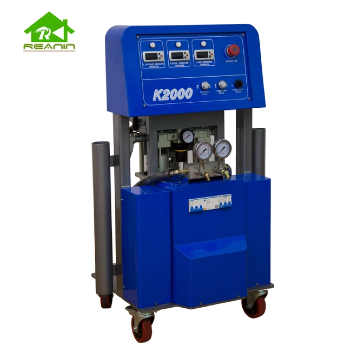
Short-range hose configurations are highly efficient for specific applications. A length of 50 to 150 feet is generally adequate for small-to-medium residential spaces, touch-up work, and OEM manufacturing environments where the machine is stationed close to the application area. These setups minimize pressure loss and ensure excellent thermal control. The fluid spends less time in transit, meaning the primary heaters on the proportioner do the majority of the work, and the hose simply maintains that baseline.
These shorter lengths are highly compatible with entry-level systems or a standard pneumatic polyurethane foaming machine. Because these machines often have limited transformer output and smaller fluid sections, keeping the hose length under 150 feet ensures the equipment operates within its safe parameters without stalling or losing heat. Operators running pneumatic systems will find that shorter hoses prevent the air motor from icing up, as the pump does not have to cycle as rapidly to maintain pressure against massive friction loss.
The 200 to 250-foot range is widely considered the industry baseline for standard rig operations. This length allows the mobile rig to remain parked safely on the street or in a driveway while providing enough reach to cover most residential and light commercial jobs. It eliminates the need to constantly reposition the trailer, which saves hours of labor over a workweek.
Most contractors recommend at least 250 feet of hose because it achieves the ideal balance between site accessibility and thermal control. It provides enough flexibility for the applicator without overwhelming the standard transformers found in mid-range proportioners. You can reach the attic of a standard two-story home from the curb without stretching the hose to its breaking point.
This length is particularly effective when operating a closed cell foam insulation machine. Closed-cell foam requires strict temperature maintenance to achieve proper expansion and density. A 250-foot setup balances optimal reach with reliable chemical heating, ensuring the closed-cell material performs as specified by the manufacturer. The dense nature of closed-cell chemicals means that pushing them beyond 250 feet requires a significant jump in equipment power.
Extended reach operations are necessary for large-scale projects. High-rise commercial buildings, massive agricultural facilities, or highly inaccessible sites often require hose lengths between 300 and 450 feet. These setups demand powerful equipment capable of pushing heavy fluids vertically and over long horizontal distances. Vertical lift adds head pressure, compounding the friction loss experienced in horizontal runs.
Mid-range hydraulic equipment typically maxes out around 310 feet of hose. Attempting to push 500 to 600 feet of hose is highly risky without specialized auxiliary heat and booster setups. The friction loss over that distance will stall standard pumps and overwhelm standard transformers, leading to immediate application failure. The heating elements simply cannot keep up with the heat loss over half a thousand feet of exposed hose.
To successfully operate at these extreme lengths, contractors must utilize heavy-duty equipment. A high-capacity polyurethane injection machine with a massive transformer and larger fluid sections is required. In many cases, booster pumps are necessary to maintain adequate pressure at the gun over 400 feet. Operators must also factor in the physical weight of 450 feet of fluid-filled hose, which often requires a dedicated crew member just to manage the line and prevent snags.
The type of drive system powering your proportioner dictates its ability to handle extended hoses. Pneumatic, hydraulic, and electric drive systems handle the strain of pushing chemicals differently. Pneumatic systems are excellent for shorter runs but can struggle with pressure drops over long distances due to air compressor limitations. When a pneumatic pump faces high resistance from a long hose, it consumes massive amounts of CFM, often outstripping the compressor's recovery rate.
Hydraulic systems generally offer the sustained, relentless pressure required for maximum hose lengths. They do not rely on compressible air, allowing them to push thick chemicals through 300+ feet of hose without stalling or losing significant pressure at the gun. Electric systems fall in the middle, offering consistent pressure but sometimes lacking the raw pushing power of a hydraulic setup when dealing with cold, highly viscous closed-cell materials.
Drive System Type |
Max Recommended Hose Length |
Pressure Consistency over Distance |
Best Application Environment |
|---|---|---|---|
Pneumatic |
150 - 210 Feet |
Moderate (Prone to pressure drop) |
Residential, touch-ups, in-plant OEM. |
Electric |
210 - 310 Feet |
High (Consistent stroke) |
Standard commercial, mid-size residential. |
Hydraulic |
310 - 450+ Feet |
Very High (Relentless pushing power) |
High-rise, large agricultural, heavy commercial. |
Hose specifications must match the machine's output. Low-pressure systems typically utilize 3/8-inch hoses rated for 2000 PSI. In contrast, high-pressure configurations require robust 1/4-inch or 3/8-inch hoses rated for at least 3000 PSI to handle the intense fluid dynamics. Using a 2000 PSI hose on a machine capable of generating 3500 PSI is a severe safety violation that will result in a blowout.
The standard configuration involves a 3/8-inch main hose running from the machine, terminating in a 1/4-inch whip hose. The whip hose is typically 10 to 20 feet long and provides the applicator with necessary gun maneuverability. It is absolutely critical to match the hose burst ratings to the machine's maximum output to prevent dangerous ruptures on the job site. The smaller diameter of the whip hose increases fluid velocity right before the mixing chamber, aiding in atomization, but it also creates a bottleneck that adds to the overall friction loss.
The type of material being sprayed influences hose length decisions. The specific gravity and blowing agents of different foams interact with hose length and temperature differently. Open-cell foam is generally lighter and more forgiving regarding temperature fluctuations. You can often push open-cell foam slightly further than closed-cell foam on the same machine because it is less viscous.
Closed-cell foam typically requires stricter temperature and pressure parameters. The heavier material is harder to push, making excessive hose lengths riskier without high-end equipment. If the closed-cell material cools in a long hose, the yield will plummet, and the foam may shrink or pull away from the substrate. When spraying closed-cell foam in winter, contractors often reduce their total hose length by 50 feet just to ensure the material stays hot enough to react properly.
Heated hoses are highly vulnerable on construction sites. They are subjected to severe abrasion from being dragged across concrete, exposed to moisture, and risk internal wire breakage if handled roughly. A damaged heated hose is a massive financial loss and causes immediate downtime. The copper heating wires wrapped around the fluid lines are fragile; bending the hose past its minimum radius will snap these wires, creating a cold spot that ruins the chemical mix.
Evaluating the return on investment for premium hose wraps is straightforward. Using heavy-duty scuff jackets or specialized wraps extends the hose lifespan significantly. These wraps protect against external abrasion and provide an extra layer of insulation, helping retain heat and reducing the strain on the machine's transformer. In cold climates, an uninsulated hose lying on frozen concrete will lose heat faster than the transformer can replace it, regardless of the machine's size.
Install a heavy-duty scuff jacket over the entire length of the heated hose before deploying it on a job site.
Elevate the hose off frozen ground or wet surfaces using blocks or stands to prevent rapid thermal transfer.
Inspect the outer jacket weekly for cuts, abrasions, or exposed heating wires, repairing any damage immediately with approved electrical tape and shrink wrap.
Never pull the hose by the gun manifold; always grab the hose itself to relieve stress on the fluid fittings.
Unequal pressure drops between the A-side (Isocyanate) and B-side (Resin) over long distances lead directly to off-ratio foam. If one chemical is thicker or colder than the other, it will experience more friction loss, arriving at the gun at a lower pressure. This imbalance ruins the chemical reaction, resulting in spongy, brittle, or shrinking foam that must be scraped out of the wall cavity.
To mitigate this risk, operators must employ strict monitoring tactics. Regular gauge monitoring at the machine is essential. Maintaining clean Y-strainers prevents blockages that cause pressure imbalances. Finally, performing frequent yield checks and ratio tests at the gun ensures the material is mixing correctly despite the hose length. If you notice a pressure differential greater than 200 PSI between the A and B sides while spraying, stop immediately and diagnose the restriction.
Proper hose management is a safety requirement. Leaving a heated hose coiled during operation creates a severe hazard. The coiled copper heating wires create a magnetic field and induction heating effect. This concentrated heat cannot escape and will rapidly melt the hose, causing a catastrophic failure and potential fire hazard. Many new operators destroy their first set of hoses by leaving 50 feet coiled in the trailer while spraying a small job.
Standard operating procedures must dictate how the hose is laid out. Operators must uncoil the entire length of the heated hose before turning on the transformer. Lay the hose out in large, loose loops or figure-eights to prevent kinks, electrical shorts, and heat buildup. If you do not need the full 250 feet for a specific job, you must still uncoil it completely and lay it out in the driveway or yard to allow the heat to dissipate safely.
Disconnect the power to the hose transformer before moving or uncoiling the hose.
Walk the entire length of the hose out of the rig, ensuring there are no tight coils or overlapping sections.
Arrange excess hose in a wide figure-eight pattern on a flat surface to eliminate induction heating.
Turn on the transformer only after the hose is fully deployed and visually inspected for kinks.
Calculate your maximum safe hose length by checking your proportioner's transformer specifications and subtracting 50 feet if operating in winter conditions.
Install heavy-duty scuff jackets and insulation wraps on all exposed hose sections to prevent abrasion and thermal loss on rough job sites.
Implement a strict daily protocol to uncoil the entire length of the heated hose in a figure-eight pattern before activating the heating elements.
Monitor the A-side and B-side pressure gauges continuously during operation to catch friction-induced pressure imbalances before they cause off-ratio foam.
A: A standard mid-range proportioner typically supports between 210 and 310 feet of heated hose, limited primarily by the machine's electrical transformer capacity and the pump's ability to overcome friction loss.
A: Yes, if the machine cannot maintain the required heat and pressure over the extended distance. Cold chemicals increase in viscosity, leading to poor mixing, higher density foam, and significantly reduced yield per drum.
A: You can only add hose up to the maximum limit specified by your machine's transformer. Exceeding this limit will cause the heating elements to fail and the pumps to stall due to excessive friction loss.
A: A whip hose, typically 1/4-inch in diameter and 10 to 20 feet long, is lighter and much more flexible than the main 3/8-inch heated hose. It provides the applicator with the necessary maneuverability to spray accurately in tight spaces.
A: Closed-cell foam requires precise temperature control. If a hose is too long for the machine's transformer, the material cools, increasing viscosity and causing pressure imbalances that result in off-ratio, poor-quality foam.
A: The rating indicates the maximum internal pressure the hose can safely handle. Low-pressure systems use 2000 PSI hoses, while high-pressure hydraulic systems require 3000 PSI hoses to prevent dangerous ruptures during operation.
A: Leaving a heated hose coiled creates induction heating. The concentrated magnetic field generates excessive heat that cannot dissipate, which will rapidly melt the hose layers and destroy the internal heating wires.


